Surgery; its theory and practice / by William Johnson Walsham.
- William Walsham
- Date:
- 1896
Licence: Public Domain Mark
Credit: Surgery; its theory and practice / by William Johnson Walsham. Source: Wellcome Collection.
Provider: This material has been provided by the Augustus C. Long Health Sciences Library at Columbia University and Columbia University Libraries/Information Services, through the Medical Heritage Library. The original may be consulted at the the Augustus C. Long Health Sciences Library at Columbia University and Columbia University.
46/848 (page 44)
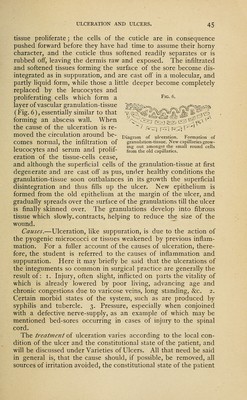
![ticable or unadvisable, a counter-opening should be made by cutting on the end of a long probe, and the sinus then drained by passing a drainage-tube at first through it, and subsequently in at each end, and gradually withdrawing the two portions as the sinus heals. At the same time that these local means are adopted, attention must be paid to the general health, as the intractabihty of a sinus may depend in part, or even entirely, upon some con- stitutional derangement. The treatment of special fistulge is else- where described. {?)ttfistula in ano, etc.) ULCERATION AND ULCERS. Ulceration is another of the terminations of inflammation, and as we have already seen, merely differs from suppuration in that the one occurs in the substance of the tissues, the other on the free surface. In both there is minute disintegration and liquefaction of the tissues, with infiltration of leucocytes and pro- liferation of tissue-cells and degeneration and death of some of the infiltrating leucocytes and proliferated tissue-cells; in sup- puration, however, the infiltrating and proliferating cells being unable to escape from an abscess, whilst in ulceration the broken- down tissues and pus are cast off as soon as formed as a discharge or ichor. An abscess may therefore be said to be a closed ulcer, an ulcer an open abscess. This molecular death of the tissues serves to distinguish ulceration from gangrene, in which the tissues die en masse and are cast off in the form of a slough. The two processes, however, are frequently combined. The softening and breaking down of a new growth, though not generally due to inflammation, is also spoken of as ulceration. Ulceration may occur in any tissue of the body. Here, however, our description will chiefly apply to the process as it affects the skin or mucous membrane. Let us first study the process as it may be followed with the naked eye in a portion of inflamed skin. The cuticle in the centre of the inflamed spot separates or is rubbed off, and a raw surface is thus left which gradually enlarges in depth and ex- tent, leaving an angry-looking sore exuding a sanious discharge. Supposing the destructive process to now cease, minute red points called granulations spring up from the surface of the sore, and the discharge is replaced by ])us. The ulcer skins over from the margins, till the raw surface is thus covered in, and finally a scar only is left to mark the situation of the former wound. The Minute C/ian_s;es are as follows :—The tissues at the focus (){ inflammation where stasis has already occurred become in- filtrated with serum and leucocytes ; the cells of the Malpighian layer of the epidermis, of the dermis, and of the subcutaneous](https://iiif.wellcomecollection.org/image/b2120472x_0046.jp2/full/800%2C/0/default.jpg)