Chemical examination of the root and leaves of Morinda longiflora / by Marmaduke Barrowcliff and Frank Tutin.
- Barrowcliff, Marmaduke.
- Date:
- [1907?]
Licence: In copyright
Credit: Chemical examination of the root and leaves of Morinda longiflora / by Marmaduke Barrowcliff and Frank Tutin. Source: Wellcome Collection.
14/16 page 1918
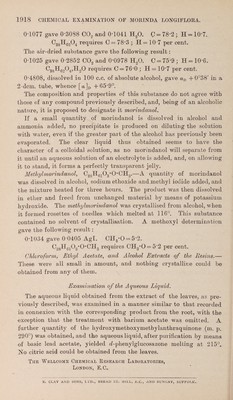
![0‘1077 gave 0*3088 C02 and 0-1041 H20. C = 78-2; H = 10*7. ^38^-62^4 squires C = 78*3 ; H = 10 7 per cent. The air-dried substance gave the following result: 0-1025 gave 0-2852 C02 and 0-0978 H20. C = 75‘9; H=10’6. C38H6204,H20 requires C = 76-0; H = 10• 7 per cent. 0*4808, dissolved in 100 c.c. of absolute alcohol, gave aD + 0°38' in a 2-dcm. tube, whence [a]D +65-9°. The composition and properties of this substance do not agree with those of any compound previously described, and, being of an alcoholic nature, it is proposed to designate it morindanol. If a small quantity of morindanol is dissolved in alcohol and ammonia added, no precipitate is produced on diluting the solution with water, even if the greater part of the alcohol has previously been evaporated. The clear liquid thus obtained seems to have the character of a colloidal solution, as no morindanol will separate from it until an aqueous solution of an electrolyte is added, and, on allowing it to stand, it forms a perfectly transparent jelly. Methylmorindanol, C3SH6103*(>CH3.—A quantity of morindanol was dissolved in alcohol, sodium ethoxide and.methyl iodide added, and the mixture heated for three hours. The product was then dissolved in ether and freed from unchanged material by means of potassium hydroxide. The methylmorindanol was crystallised from alcohol, when it formed rosettes of needles which melted at 116°. This substance contained no solvent of crystallisation. A methoxyl determination gave the following result: 0T034 gave 0-0405 Agl. CH3*0 = 5*2. C38H6103*OCH3 requires CH3*0 = 5*2 per cent. Chloroform, Ethyl Acetate, and Alcohol Extracts of the Resins.— These were all small in amount, and nothing crystalline could be obtained from any of them. Examination of the Aqueous Liquid. The aqueous liquid obtained from the extract of the leaves, as pre¬ viously described, was examined in a manner similar to that recorded in connexion with the corresponding product from the root, with the exception that the treatment with barium acetate was omitted. A further quantity of the hydroxymethoxymethylanthraquinone (m. p. 290°) was obtained, and the aqueous liquid, after purification by means of basic lead acetate, yielded d-phenylglucosazone melting at 215°. jSio citric acid could be obtained from the leaves. The Wellcome Chemical Research Laboratories, London, E.C. R. CLAY AND SONS, LTD., BREAD ST. HILL, E.C., AND BUNGAY, SUFFOLK.](https://iiif.wellcomecollection.org/image/b3061174x_0014.jp2/full/800%2C/0/default.jpg)