Celebration of the semi-centennial anniversary of the graduation in medicine of Constantine Hering, M.D.
- Date:
- [1876]
Licence: Public Domain Mark
Credit: Celebration of the semi-centennial anniversary of the graduation in medicine of Constantine Hering, M.D. Source: Wellcome Collection.
Provider: This material has been provided by the Francis A. Countway Library of Medicine, through the Medical Heritage Library. The original may be consulted at the Francis A. Countway Library of Medicine, Harvard Medical School.
19/48 page 11
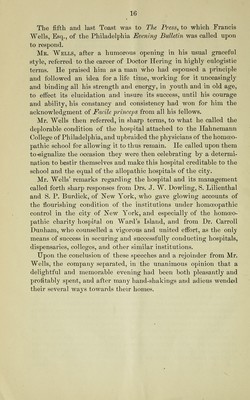
![The remarkable thing about this is, they made an old school doctor of him, and he survived it. Survived it, retaining his earliest, early and later thirst for knowl- edge, with increasing diligence in its pursuit. This is certainly very remarka- ble, in view of the known fact that a young doctor no sooner lays his hand on the precious parchment, than he is seized with the absorbing conceit that now he knows all about it. This is es])ecially apparent in the case of old-school young doctors. Under the influence of this delusion they almost uniformly drift away together into a total darkness as to all laws which can throw light on the science of therapeutics or direct its practice. The escape of our young friend from this common fate, can only be explained when we know the fac-t that i>re- vious to the reception of this doctorate, he had become a convert to the truths of homoeopathy. This saved him. Anchored to these he went out to bless the world by teaching them to others, and in the exercise of his pristine restless activity, to advance from these to a knowledge of new facts and principles in harmony with them, till he had gathered from his survey of the broad field of nature before him, such stores of knowledge of phenomena of disease, the effects of external agents on the living organism, the relations of these latter to the former, which constitute them their curatives, that he soon stood before the profession an acknowledged master, the peer of the noblest of them all. Having accomplished the objects of his mission to Surinam, he started for his native country, in his progress to which he landed in Philadelphia, in January, 1833, w4th the purpose of soon resuming his journey, and in Dresden again to return to his official duties in the Institute, to the official staff of which he was still attached. But this he was never more to do. Providence blessed us by permitting him, who had mastered the plaiiets and the lightning, to be himself conquered by the conqueror of us all, sooner or later. I need not say that victor was a lovely woman. She cast her spell over him and he was bound by it and could go no further. She became his, and through her power over him he became hers and ours from thenceforth. These were the circumstances and this the manner of the advent among us, now more than forty-three years ago, of the man from whom has gone out, more than from any and all others, light and teaching which have made homoeopathy what it is in the land to-day, a recognized power of beneficence, which, who- ever will, may hate, but only the recklessly daring will longer make the object of a sneer, as all did at the beginning of his career among us, even the most pusillanimous and contemptible. It may be well to look a moment at the state of things in the country at that time, as to all belonging to his favorite doctrines and practice. There were no text-books in the language of the country, from which, if any were desirous of doing so, they could learn its principles. There were no manuals of Materia IVfedica or repertories to aid any who might wish to make practical application of the law of cure which homoeopathy had proclaimed. There w^as almost no literature from which a knowledge of that system of curing, so generally believed to be absurd and as generally ridiculed, could be obtained. There were no schools where the homoeopathic system of medicine w^as taught. There was here and there one scattered over the Eastern part of the country (with one exception, not two in any one place), but few altogether, w'ho were endeavoring to practice, in part or in whole, with the light w'hich was in them, according to the law of healing which Hahnemann had promulgated. These, taken as a whole, were not sufficient to modify in a great degree the total darkness which prevailed, as to all knowledge of natural law- or principles controlling the thera-](https://iiif.wellcomecollection.org/image/b21045616_0019.jp2/full/800%2C/0/default.jpg)


 No text description is available for this image
 No text description is available for this image
 No text description is available for this image