A report to the Surgeon General on the transport of sick and wounded by pack animals / by George A. Otis.
- George Alexander Otis
- Date:
- 1877
Licence: Public Domain Mark
Credit: A report to the Surgeon General on the transport of sick and wounded by pack animals / by George A. Otis. Source: Wellcome Collection.
20/48 page 10
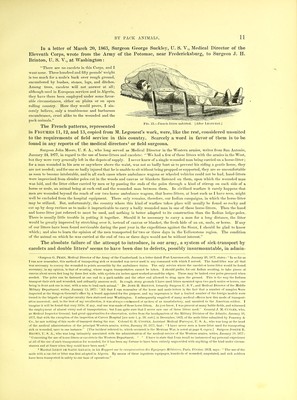
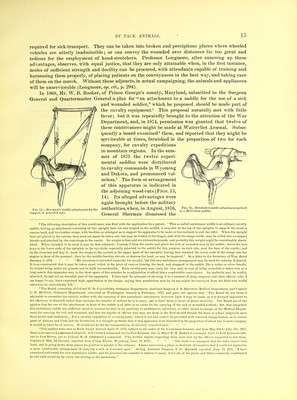
![the Surgeon General requested the Quartermaster's Department to provide three hundred litters, and this number was purchased of Mr. G. Kohler.1 Prior to the battle of Antietam, Medical Director Letterrnau asked for a supply of mules equipped with cacolets and litters. The Quarter- master's Department had an ample supply of the French patterns, which were beyond all ques- tion the best that had been devised at that time. But there were no trained ani- mals to bear them, and few, if any, available skilled pack- ers. September 1, 1862, the Surgeon General requested that a hundred mule-litters should be sent to Medical Inspector K. H. Coolidge. A few weeks after the battle of Antietam a hundred and fifty mules were sent to the Array of the Potomac for FIG. 11.—French litiere folded. [After LEGOUEST.] ambulance service, but they Fig. 12.—French cacolet unfolded. Legouest.1 [After were so unruly that it was thought unwise to pack them with their equipment, and the litters and cacolets were sent along in wagons, and, as far as can be learned, never found their way to the backs of the mules.2 Little could be anticipated from such essays. In November, 1862, the Surgeon General made another requisition for a hundred and fifty mules with drivers, with a view of having them drilled with cacolets in the field, by Dr. Slade Davis; but this, like previous experiments in this direction, proved abortive; and the ambulance material for transport by pack-animals, accumulated at no inconsiderable cost, was never really tested in the field.' There seems to have been a widespread distrust of the system on the part of officers of the Quartermaster's and the Medical Departments. 1 June 17, 1862, Colonel Rucker advises the Quartermaster General that he has advertised for proposals for mule-litters, and that the only pro- posal received is from Mr. G. KOHLER, and that the litter he proposes to furnish seems to be very high-priced; it is intricate and cumbersome in construction, and, in my opinion, inferior to those now in Captain Dana's store-house'' [the French cacolet and litiere]. July 2ft, 1862, Surgeon-General Hammond states, in reply to a letter from the Quartermaster General concurring in Colonel Rucker's opinion :* * The litter presented by Mr. Kohler has been examined by myself and a board of officers, who agree that it possesses sufficient merit to entitle it to trial in the field. I therefore request that three hundred of the mule-litters presented by Mr. KOHLER be purchased for the use of the army. Quartermaster General Meigs replies, July 29, 18C2, that * * inasmuch as the Surgeon General adopts and requests that these litters be constructed, though in the opinion of the Quarter- master's Department they are not as good as those already on hand, they will be contracted for under the proposal of Mr. Kohler. The price bid is understood, as in other cases, to include the whole set, namely, head stall, harness, saddle, and two litters for each mule. As early as Decernber 9, 1861, this pattern of mule-litter had been reported on by a board convened by General McClellan, consisting of Col. D. H. RUCKER, Surgeon C. H. I-iAUB, and Surgeon J. R. Smith, it is presumed unfavorably, as further action was not had at the time. 2 In October, 1862, the Surgeon General again made requisition on the Quartermaster's Department for one hundred and fifty mules provided with mule-litters, to be sent to Dr. Jonathan Letterman, Medical Director of the Army of the Potomac. In reference to delay in compliance with this requisition, Captain J. J. Dana, A. Q. M., reported, October 17, 1862, as follows: The order was given by me, October 3d, immediately on its receipt, for one hundred and fifty mules and litters to be made ready for service. At that time we had no mules sufficiently well broken for the purpose. I directed ■fifty of the best to be taken from the ambulance train, the litters to be fitted upon them, and the mules drilled daily until they were fit to go into the field. On the 9th of October, fifty mules with litters upon them were started for Dr. Letterman. Much difficulty was experienced in getting the mules forward, as they were, many of them, inclined to lie down and were otherwise unruly. Among a lot of mules received on the 10th instant, we found one hundred which were to some extent suitable for the purpose, and were sent forward on the 11th instant, the litters being sent by wagons in order t» expedite the matter. October 3, 1862, Quartermaster-General Meigs, in transmitting this report to Surgeon-General Hammond, stated: I desire respectfully to call your attention to the fact mentioned in the report : that there are a large number of cacolets now in the possession of the Government which appear to have been overlooked by the officers of your department, and to suggest the expediency of directing their availing themselves of them as occasion may arise. General McClellan issued orders, a year ago, for drill and practice of ambulance men, including, as I understand, the use of the mule-litters, of which, of French and American manufacture, there were then a considerable number provided by the Quartermaster's Department. Those lately purchased from Mr. Kohler, on the requisition of the Surgeon General, cost $21,000, and are still in store. 3 From the papers laid before the Quartermaster General to-day, there appears an expenditure for purchase of cacolets and litters in 1861 and 1862 for the Army, partly upon requisions from the Surgeon General, partly from orders originating in this office, of over $20,000. To this, if the cost of animals and use of men, of forage, &o., supplied by this Department for the experiment of introducing these litters and cacolets, it would be found that not less than $100,000, and probably more has been expended in an experiment which was, so far as information in this office goes, entirely unsuccessful. There never was, to the knowledge of the Quartermaster General, a requisition from any military commander. All the requisitions came from the Surgeon General's office. It is not known to this office that these mule-litters ever were used in service, and the Quartermaster General believes that no wounded man was ever placed upon one of them. While the wheeled ambulances and hand-litters provided for the hospital equipments were in constant and useful use, the litters burdened the trains, and the mules were by the ordinary accidents of service taken for the ambulances and wagons. He believes that no better cacolet or mule-litter will be constructed than the French cacolet and litter, ordered at the beginning of the rebellion; and these, which though in his judgment inferior, were, at a later period, bought at the urgent requisition of the then Surgeon General. He is, therefore, of opinion that any further expenditure by this Department in this line of experiment will be a waste of public money, and he will not, therefore, unless under order of higher authority, expend money or make reports upon any models thus far submitted to him.—Mem. of Quartermaster General, December 23, 1868.](https://iiif.wellcomecollection.org/image/b21779156_0020.jp2/full/800%2C/0/default.jpg)