A report to the Surgeon General on the transport of sick and wounded by pack animals / by George A. Otis.
- George Alexander Otis
- Date:
- 1877
Licence: Public Domain Mark
Credit: A report to the Surgeon General on the transport of sick and wounded by pack animals / by George A. Otis. Source: Wellcome Collection.
27/48 page 17
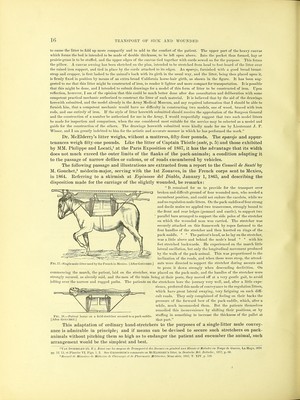
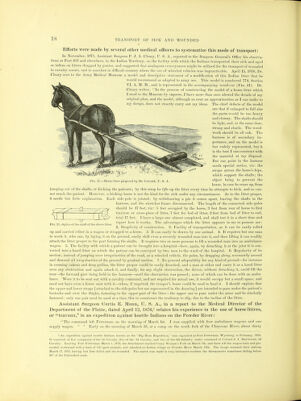
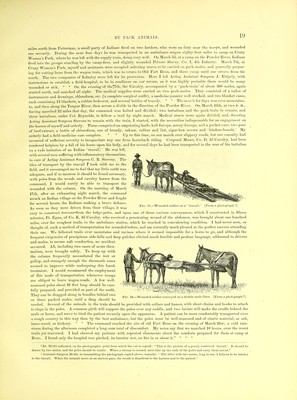
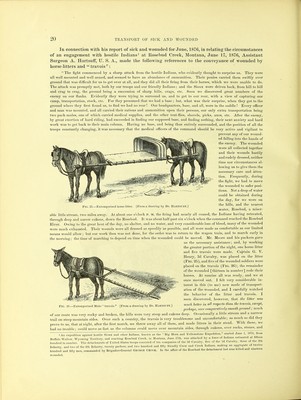
![A mode of transporting sick and wounded by conveyances that at one end rest on the ground, so that the patient is drawn, but only partially sustained, by the pack-animal, is mentioned by early travellers among the North American Indians. Parkman indicates1 that in the war with Pontiac, in 17G3, the colonists carried their wounded by this contrivance, and, in a later work,2 refers to the travail used by the Oregon Indians; and Lewis and Clark3 resorted to it in 1805, to carry a wounded hunter of their party. Latterly, this method of transport has received much attention from medical officers, as well adapted to the exigencies of frontier service. Surgeon C. R. Greenleaf, U. S. A., has remarked on this form of conveyance: I know of nothing better for scouting parties, than a litter made after the following plan, which is borrowed from a custom among the Indians, quite familiar to all officers who have seen any service on our frontiers. It consists of four ash poles, two for shafts and two for litter-poles—the former are 7 feet 6 inches long, 2 inches wide, 2f inches deep at the butt, and If xlf inches at the point; the latter are 8 feet 6 inches long, 2 inches wide, and 2f inches deep, with rounded edges and comers. On one end of the litter-pole is riveted two wrought-iron (best Norway) bands i inch thick and 1-J inch wide. One of these collars is set 2 inches from the end of the litter-pole, and has a diameter of 4-f inches by 2 inches; the other is set 12 inches from the end of the poles, and has a diameter of 5f inches by 2 inches. The opposite end of the litter-pole is shod with an iron thimble 1 foot long. Two cross-bars, 30xl|x2£ inches, with a square collar of iron i inch thick by 1£ inch wide on each end, serve to keep the poles separated and steady; the collars should have a diameter of 2x2f inches, and the litter-pole must be square at its front end and 2^ feet from the rear end for their reception. A canvas bed 6 feet by 32 inches, with strongly bound eyelets 8 inches apart on the upper end and upper three feet of the sides, and perma- nently fastened to the Fig. 19.—GREENLEAF's combined hand and horse litter hitched to a mule. [From a drawing by Dr. GREENLEAF.] lower three feet of the sides, completes the affair. The litter is dragged by a horse or mule hitched into the shafts—the rear end of the litter-poles resting on the ground, the patient occupying the canvas bag in the middle. To put it together, the small end of the shaft is passed from behind forward, through the rear and largest collar on the front end of the litter-pole, thence through the smaller collar, and then pulled home, until the butt of the shafts is tightly embraced by the collars; the cross-bars are then put into their respective places by slipping their collars over the front and rear ends of the litter-poles and pushing them securely home, the canvas bed lashed to the poles by rope passing through the side eyelets and around the poles, and through the end eyelets and around the cross-bars; the ropes at the head of the bed should be slack, to afford bag enough to the canvas to bring the head and shoulders of the patient nearly on a level with his feet. By the arrangement of splicing the shafts to the litter-poles through collars of unequal sizes, a constant tightening of the parts goes on by the force exerted by the animal in pulling the litter, and no opportunity for loosening occurs; while, as the greatest weight occurs at this point, additional strength is gained through the iron collar and the double thickness of pole. With a collar and harness, which could be carried without much trouble, the litter can be hitched to a mule by a chain attached to the harness, and having on its end a goose- neck pin to pierce the shaft from below, and be fastened above by a nut or linch-pin. To unship the litter, give a smart blow on the small end of the shaft, which will drive it back through the collars, when it can be taken out; remove the cross-bars, unfasten the ropes, and wrap the poles and cross-bars in the canvas, packing the whole thing like a tent on a pack-mule. For use as a hand-litter, it is only necessary to unship the shafts.4 'PAHKMAN (F., .jr.), History of the Conspiracy of Pontiac and the War of the North American Tribes, Boston, 1855, p. 601. After the battle of Bushy Run, August 6, 1763, Colonel H. BOUQUET wrote to his excellency, Sir J. Amherst, describing the litters constructed after the Indian fashion by the four companies under his command to carry off their wounded. 2 PARKMAN (F., jr.), California and Oregon Trail, being sketches of Prairie and Rocky Mountain Life : 12 mo., New York, 1849, p. 165. 3 History of the Expedition under the command of Captains LEWIS and CLARK to the sources of the Missouri, thence across the Rocky Mountains and down the River Columbia to the Pacific Ocean, performed during the years 1804-5-6, by order of the Government of the United States. By PAUL ALLF.N, esquire, Philadelphia, 1814, Vol. II, p. 381. 4 Extract from a Report made in compliance with Circular Orders No. 3, War Department. S. G. O., November 25, 1874, by Assistant Surgeon Chari.es R. Greenleaf, U. S. A., dated Huntsville, Alabama, December 14, 1874. On October 27, 1876, Dr. Greenleaf contributed to the Army Medical Museum a model of this combined hand- and horse-litter, which is numbered 804 in Section VI, A. M. M. 3](https://iiif.wellcomecollection.org/image/b21779156_0027.jp2/full/800%2C/0/default.jpg)