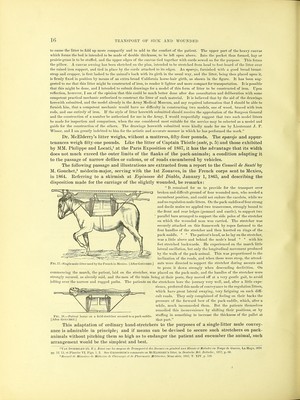
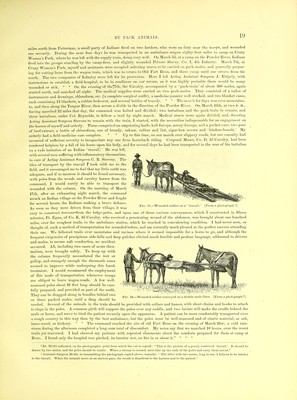
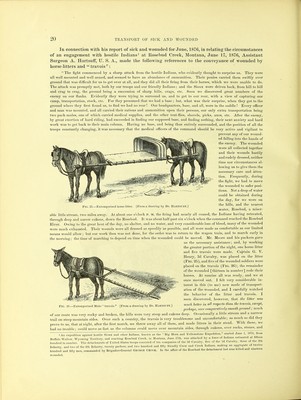
A report to the Surgeon General on the transport of sick and wounded by pack animals / by George A. Otis.
- George Alexander Otis
- Date:
- 1877
Licence: Public Domain Mark
Credit: A report to the Surgeon General on the transport of sick and wounded by pack animals / by George A. Otis. Source: Wellcome Collection.
28/48 page 18
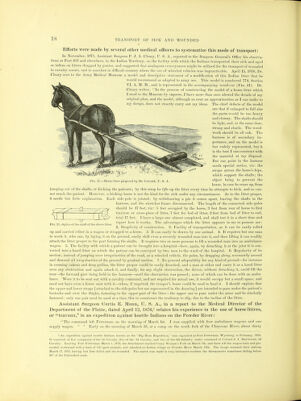
![-Horse-litter proposed by Dr. Cleary, TI. S. A. Efforts were made by several other medical officers to systematize this mode of transport: In November, 1875, Assistant Surgeon P. J. A. Cleary, U. S. A., reported to the Surgeon General's Office his observa- tions at Fort Sill and elsewhere, in the Indian Territory, on the facility with which the Indians transported their sick and ased or infirm on litters dragged by ponies, and suggested that analogous conveyances might be utilized for the transport of wounded in cavalry scouts, and in inarches in difficult country where the use of wheeled vehicles was impracticable. April 15, 1876, Dr. Cleary sent to the Army Medical Museum a mode) and descriptive statement of a modification of this Indian litter that he would recommend as adapted to army use. This model is numbered 774, Section VI, A. M. M., and is represented in the accompanying wood-cut (FlG. 21). Dr. Cleary writes: In the process of constructing the model of a horse-litter which I send to the Museum by express, I have more than once altered the details of my original plan, and the model, although as near an approximation as I can make to my design, does not exactly carry out my ideas. The chief defects of the model are that if enlarged to full size the parts would be too heavy and clumsy. The shafts should be light, and. at the same time, strong and elastic. The wood- work should be all oak. The harness is of secondary im- portance, and on the model is but rudely represented, but it is the best I can construct with the material at my disposal. But one point in the harness needs special notice, viz: the straps across the horse's hips, which support the shafts; the object being to prevent the horse, in case he rears up, from jumping out of the shafts, or kicking the patients; by this strap he lifts up the litter every time he attempts to kick, and so can- not reach the patient. However, a kicking horse is not the kind for the sick under any circumstances. As to the litter proper, it needs but little explanation. Each side-pole is jointed; by withdrawing a pin it comes apart, leaving the shafts in the harness, and the stretcher-frame disconnected. The length of the connected side-poles should be 17 feet, viz : 5 feet occupied by the horse, 3 feet from rear of horse to first traverse or cross-piece of litter, 7 feet for bed of litter, 2 feet from bed of litter to end, total 17 feet. I have a large one almost completed, and shall test it in a short time and report how it works. The advantages which the litter appears to me to possess are: 1. Simplicity of construction. 2. Facility of transportation, as it can be easily rolled up and carried either in a wagon or strapped to a horse. 3. It can easily be drawn by one animal. 4. It requires but one man to work it, who can, by laying it on the ground, easily shift even a severely wounded man into it, and then lifting it can readily attach the litter proper to the part forming the shafts. It requires two or more persons to lift a wounded man into an ambulance wagon. 5. The facility with which a patient can be brought into a hospital—here, again, by detaching it at the joint it is con- verted into a hand-litter on which the patient can be conveyed by two men to the ward of the hospital. 6. Regularity of its motion; instead of jumping over irregularities of the road, as a wheeled vehicle, the poles, by dragging along, necessarily ascend and descend all irregularities of the ground by gradual motion. 7. Its general adaptability for any kind of ground—for instance in crossing canons and deep gullies, the litter proper could be easily detached, and a man at either end carry it as a hand-litter over any obstruction and again attach it, and finally, for any slight obstruction, the driver, without detaching it, could lift the rear—the forward part being held in the harness—until the obstruction was passed ; none of which can be done with an ambu- lance. Were it to be sent out with a cavalry command, and not required for actual use, it would occupy but a small space, and need not have even a horse sent with it—when, if required, the trooper's horse could be used to haul it. I should explain that the upper and lower straps [attached to the side poles but not represented in the drawing] are intended to pass under the patient's buttocks and over the thighs, fastening to the upper part of the litter—the upper one to pass under the arms and be similarly fastened; only one pair need be used at a time, this to counteract the tendency to slip, due to the incline of the litter.. Assistant Surgeon Curtis E. Mann, U. S. A., in a report to the Medical Director of the Department of the Platte, dated April 12, 1876,1 relates his experience in the use of horse-litters, or travaux, in an expedition against hostile Indians on the Powder River: The command left Fetterman on the morning of March 1st. I was supplied with four ambulance wagons and one supply wagon. * * Early on the morning of March 3d, at a camp on the south fork of the Cheyenne River, about thirty 1 An expedition against hostile Indians, known as the Big Horn Expedition, was organized at Fort Fetterman, Wyoming, in February, 1876. It consisted of five companies of the 2d Cavalry, five of the 3d Cavalry, and two of the 4th Infantry, under command of Colonel J. J. REYNOLDS, 3d Cavalry. Leaving Fort Fetterman March 1, 1876, the detachment reached Crazy Woman's Fork on March 7th, and there left the wagon-train and pro- ceeded northward with a train of 350 pack-animals, and attacked an Indian village on Powder River March 17th. The troops resumed their stations March 27, 1876, having lost four killed and six wounded. The march was made in very inclement weather, the thermometer sometimes falling below 26° of the Fahrenheit scale. LU Fie. 22.-Splice of the shaft of the above litter.](https://iiif.wellcomecollection.org/image/b21779156_0028.jp2/full/800%2C/0/default.jpg)