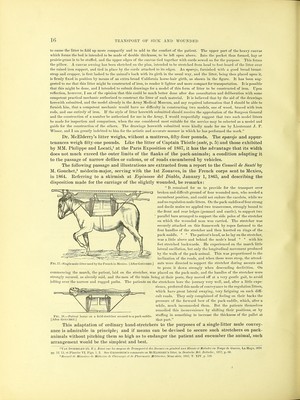
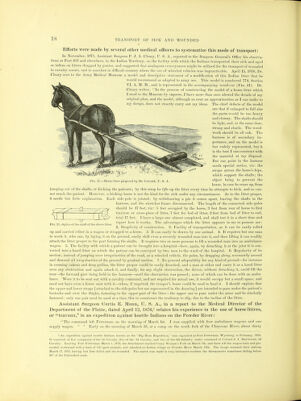
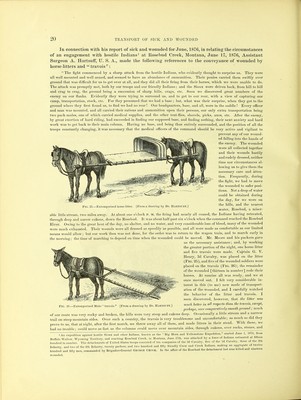
A report to the Surgeon General on the transport of sick and wounded by pack animals / by George A. Otis.
- George Alexander Otis
- Date:
- 1877
Licence: Public Domain Mark
Credit: A report to the Surgeon General on the transport of sick and wounded by pack animals / by George A. Otis. Source: Wellcome Collection.
29/48 page 19
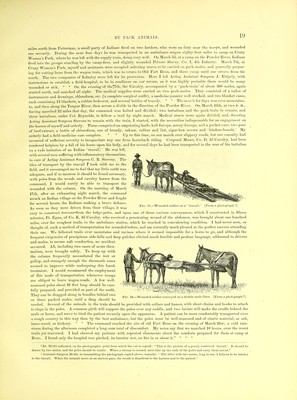
![miles north from Fetterman, a small party of Indians fired on two herders, who were on duty near the troops, and wounded one severely. During the next four days he was transported in an ambulance wagon eighty-four miles to camp on Crazy Woman's Fork, where he was left with the supply train, doing very well. On March 3d, at a camp on the Powder River, Indians fired into the groups standing by the camp-fires, and slightly wounded Private Slavey, Co. I, 4th Infantry. March 7th, at Crazy Woman's Fork, mvself and assistants were occupied selecting stores to be carried on pack-mules, and generally prepar- ing for cutting loose from the wagon train, which was to return to Old Fort Reno, and there cam]) until our return from the north. The two companies of Infantry were left for its protection. Here I left Acting Assistant Surgeon J. Ridgely, with instructions to establish a field-hospital, to be in readiness on our return, as it was highly probable there would be many wounded or sick. * * On the evening of the*7th, the Cavalry, accompanied by a 'pack-train' of about 360 mules, again started north, and marched all night. The medical supplies were carried on two pack-mules. They consisted of a valise of instruments and dressings, chloroform, etc. (a complete surgical outfit), a medicine pannier well stocked, and two blanket cases, each containing 12 blankets, a rubber bedcover, and several bottles of brandy. * * The march for days was over mountains, to and then along the Tongue River, then across a divide in the direction of the Powder River. On March 16th, at two P. M., having marched 22 miles that day, the command was halted and divided; two battalions and the pack-train to remain, anil three battalions, under Col. Reynolds, to follow a trail by night march. Medical stores were again divided, and, directing Acting Assistant Surgeon Stevens to remain with the train, I started, with the necessities indispensable for an engagement on the horses of myself and orderly. These comprised an amputating knife, ball-forceps, artery-forceps, and a pocket-case, two pots of beef-extract, a bottle of chloroform, one of brandy, oakum, rollers and lint, cigar-box covers and 'binders-boards.' My orderlv had a field-medicine case complete. * * Up to this time, on our march over slippery roads, but one casualty had occurred of sufficient severity to incapacitate any one from horseback riding Corporal Moore, Co. D, 3d Cavalry, had been rendered helpless by a fall of his horse upon his body, and for several days he had been transported in the rear of his battalion on a rude imitation of an Indian 'travail.' He was left, with several men suffering with inflammatory rheumatism, in care of Acting Assistant Surgeon C. R. Stevens. The idea of transport by the travail I took with me to the field, and it encouraged me to feel that my little outfit was adequate, and if to-morrow it should be found necessary, with poles from the woods and cavalry horses from the command, I would surely be able to transport the wounded with the column. On the morning of March 17th, after an exhausting night march, the command struck an Indian village on the Powder River and fought for several hours, the Indians making a brave defence. As soon as they were driven from their village, it was easy to construct travaux»{vom the lodge-poles, and upon one of these curious conveyances, which I constructed in fifteen minutes, Pt. Egan, of Co. K, 2d Cavalry, who received a penetrating wound of the abdomen, was brought about one hundred miles, over the roughest trails, to the ambulance station, which he reached in convalescing condition. I had never seen, or thought of, such a method of transportation for wounded before, and am naturally much pleased at the perfect success attending their use. We followed trails over mountains and ravines where it seemed impossible for a horse to go, and although the frequent exigencies of precipitous side-hills and deep gulches elicited much forcible and profane language, addressed to drivers and mules, to secure safe conduction, no accident occurred. All, including two cases of acute rheu- matism, were brought safely. To keep up with the column frequently necessitated the trot or gallop, and strangely enough the rheumatic cases seemed to improve while undergoing this harsh treatment. I would recommend the employment of this mode of transportation whenever troops are obliged to leave wagon-roads. A few well- seasoned poles about 16 feet long should be care- fully prepared, and provided as part of the outfit. They can be dragged along in bundles behind two or three packed mules, until a drag should be needed. Several of the animals in the train should be provided with collars and hames, with short chains and hooks to attach to rings in the poles. A common girth will support the poles over any saddle, and two lariats will make the cradle behind the mule or horse, and serve to bind the patient securely upon the apparatus. A patient can be more comfortably transported over a rough country in this way than by the best ambulance, but the poles must be well-seasoned and of elastic material, as ash, lance-wood, or hickory. * * The command reached the site of old Fort Reno on the evening of March 21st; a cold rain- storm during the afternoon completed a long sum total of discomfort. My notes say that we marched 10 hours, over the worst trails yet traversed. I had cheered my patients with repeated statements about the comforts prepared for them at camp at Reno. I found only the hospital tent pitched, its interior wet, no fire in or about it. * * * 'Dr. MUNN indicated, on the photographic print from which the cat is copied: This is the picture of a poorly-contrived 'travail.' It should he drawn by two mules, and the poles should be elastic. When a stream is crossed, men take up the ends of the poles and carry them across. 1 Assistant Surgeon MUNX, in transmitting the photograph copied above, remarks: The litter with two mules, long in use, 1 believe to be inferior to the travail. When the animals move at an uneven pace, the result is disastrous to the harness and to the patient. FIG. 23.—Wounded soldier on a travail.'' [From a photograph. FIG. 24.—Wounded soldier conveyed on a double mule-litter. wWm [From a photograph.2]](https://iiif.wellcomecollection.org/image/b21779156_0029.jp2/full/800%2C/0/default.jpg)