A report to the Surgeon General on the transport of sick and wounded by pack animals / by George A. Otis.
- George Alexander Otis
- Date:
- 1877
Licence: Public Domain Mark
Credit: A report to the Surgeon General on the transport of sick and wounded by pack animals / by George A. Otis. Source: Wellcome Collection.
30/48 page 20
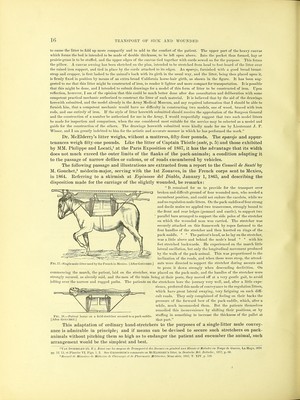
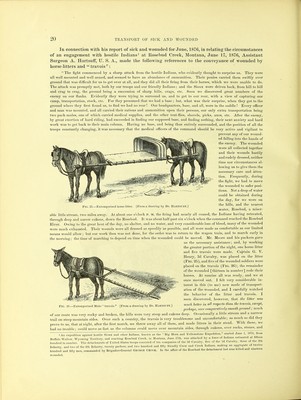
![In connection with his report of sick and wounded for June, 1876, in relating the circumstances of an engagement with hostile Indians1 at Rosebud Creek, Montana, June 17, 1876, Assistant Surgeon A. Hartsuff, U. S. A., made the followiug references to the conveyance of wounded by horse-litters and travois'': The fight commenced by a sharp attack from the hostile Indians, who evidently thought to surprise us. They were all well mounted and well armed, and seemed to have an abundance of ammunition. Their ponies carried them swiftly over ground that was difficult for us to get over at all, and they did all their firing from their horses, which we were unable to do. The attack was promptly met, both by our troops and our friendly Indians; and the Sioux were driven back, from hill to hill and crag to crag, the ground being a succession of sharp hills, crags, etc. Soon we discovered great numbers of the enemy on our flanks. Evidently they were trying to surround us, and to get to our rear, with a view of capturing our camp, transportation, stock, etc. For they presumed that we had a base; but, what was their surprise, when they got to the ground where they first found us, to find we had no rear! Our headquarters, base, and all, were in the saddle ! Every officer and man was mounted, and all carried their rations and ammunition upon their persons, our only extra transportation being two pack-mules, one of which carried medical supplies, and the other tent-flies, shovels, picks, axes, etc. After the enemy, by great exertion of hard riding, had succeeded in finding our supposed base, and finding nothing, their next anxiety and hard work was to get back to their main column. Having no base, and being thus entirely surrounded, and the position of all the troops constantly changing, it was necessary that the medical officers of the command should be very active and vigilant to prevent any of our wound- ed falling into the hands of the enemy. The wounded were all collected together and their wounds hastily and rudely dressed, neither time nor circumstances al- lowing us to give them the necessary care and atten- tion. Frequently, during the fight, we had to move the wounded to safer posi- tions. Not a drop of water could be obtained during the day, for we were on the hills, and the nearest water, Rosebud, a miser- FlG. 25.—Extemporized horse-litter. [From a drawing by Dr. HARTSUFF.] able little stream, two miles away. At about one o'clock P. M. the firing had nearly all ceased, the Indians having retreated, through deep and narow canons, down the Rosebud. It was about half-past six o'clock when the command reached the Rosebud River. Owing to the great heat of the day, no shelter, and no water, and very considerable loss of blood, many of the wounded were much exhausted. Their wounds were all dressed as speedily as possible, and all were made as comfortable as our limited means would allow; but our work then was not done, for the order was to return to the wagon train, and to march early in the morning; the time of marching to depend on time when the wounded could be moved. Mr. Moore and his packers gave us the necessary assistance; and, by working the greater portion of the night, one horse-litter and five travois were made. Captain G. V. Henry, 3d Cavalry, was placed on the litter (Fig. 25), and five of the wounded soldiers were placed on the travois (FlG. 26); the remainder of the wounded [thirteen in number] rode their horses. At sunrise all was ready, and we at once moved out. I felt very considerable in- terest in this (to me) new mode of transport- ation of the wounded, and I carefully watched the behavior of the litter and travois. I soon discovered, however, that the litter was much better in all respects than the travois, except, perhaps, over comparatively smooth ground ; much of our route was very rocky and broken, the hills were very steep and canons deep. Occasionally a little stream and a narrow trail on steep mountain sides. Over such a country, the travois is very troublesome and uncomfortable; so much so did they prove to us, that at night, after the first march, we threw away all of them, and made litters in their stead. With these, we had no trouble; could move as fast as the columns could move over mountain sides, through canons, over rocks, stones, and lAn expedition against hostile Sioux and other Indians, known as the Big Horn and Yellowstone Expedition, started June 1, 1876, from Buffalo Wallow Wyoming Territory, and reaching Rosebud Creek, in Montana, June 17th, was attacked by a force of Indians estimated at fifteen hundred in number. The detachments of United States troops consisted of ten companies of the 3d Cavalry, five of the 2d Cavalry, three of the 9th Infantry and two of the 4th Infantry, twenty packers, and two hundred and fifty friendly Crow and Creek Indians, making an aggregate of twelve hundred'and fifty men, commanded by Brigadier-General GEORGE CROOK. In the affair of the Rosebud the detachment lost nine killed and n.neteen wounded. FIG. 26.—Extemporized Mule- travois. [From a drawing by Dr. HARTSUFF.]](https://iiif.wellcomecollection.org/image/b21779156_0030.jp2/full/800%2C/0/default.jpg)