A report to the Surgeon General on the transport of sick and wounded by pack animals / by George A. Otis.
- George Alexander Otis
- Date:
- 1877
Licence: Public Domain Mark
Credit: A report to the Surgeon General on the transport of sick and wounded by pack animals / by George A. Otis. Source: Wellcome Collection.
31/48 page 21
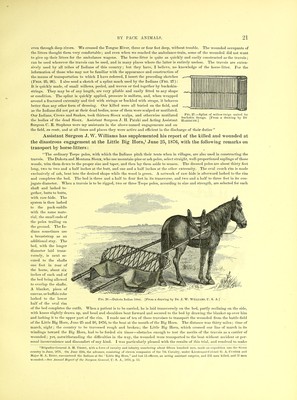
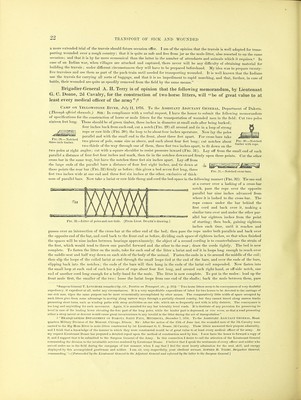
![FIG. 27.—Splint of willow-twigs united by buckskin thongs. [From a drawing by Dr Hartsuff.] even through deep rivers. We crossed the Tongue Eiver, three or four feet deep, without trouble. The wounded occupants of the litters thought them very comfortable; and even when we reached the ambulance-train, some of the wounded did not want to give up their litters for the ambulance wagons. The horse-litter is quite as quickly and easily constructed as the travois ; can be used wherever the travois can be used, and in many places where the latter is entirely useless. The travois are exten- sively used by all tribes of Indians of this country; but they have, I believe, no knowledge of the horse-litter. For the information of those who may not be familiar with the appearance and construction of the means of transportation to which I have referred, I insert the preceding sketches (Figs. 25, 26). I also send a sketch of a splint much used by the Indians (FlG. 27): It is quickly made, of small willows, peeled, and woven or tied together by buckskin- strings. They may be of any length, are very pliable and easily fitted to any shape or condition. The splint is quickly applied, pressure is uniform, and, when wrapped around a fractured extremity and tied with strings or buckled with straps, it behaves better than any other form of dressing. Our killed were all buried on the field, and as the Indians did not get at their dead bodies, none of them were scalped or mutilated. Our Indians, Crows and Snakes, took thirteen Sioux scalps, and otherwise mutilated the bodies of the dead Sioux. Assistant Surgeon J. H. Patzki and Acting Assistant Surgeon C. R. Stephens were my assistants in the above-named engagements and on the field, en route, and at all times and places they were active and efficient in the discharge of their duties' Assistant Surgeon J. W. Williams has supplemented bis report of the killed and wounded at the disastrous engagement at the Little Big Horn,1 June 25, 1876, with the following remarks on transport by horse-litters: The ordinary Teepe poles, with which the Indians pitch their tents when in villages, are also used in constructing the travois. The Dakota and Montana Sioux, who use mountain-pine or ash poles, select straight, well-proportioned saplings of those woods, trim them down to the proper size and taper, and then lay them aside to season. The dressed poles are about thirty feet long, two to two and a half inches at the butt, and one and a half inches at the other extremity. The oval couch rim is made exclusively of ash, bent into the desired shape while the wood is green. A network of raw-hide is afterward lashed to the rim and completes the bed. The bed is three and a half to four feet in its transverse, and two and a half to three feet in its con- jugate diameter. When a travois is to be rigged, two or three Teepe poles, according to size and strength, are selected for each shaft and lashed to- gether, butts to butts, with raw-hide. The system is then lashed to the pack-saddle with the same mate- rial, the small ends of the poles trailing on the ground. The In- dians sometimes use a breaststrap as an additional stay. The bed, with the longer diameter laid trans- versely, is next se- cured to the shafts one foot in rear of the horse, about six inches of each end of the bed being allowed to overlap the shafts. A blanket, piece of canvas, or buffalo robe lashed to the lower half of the oval rim of the bed completes the outfit. When a patient is to be carried, he is laid transversely on the bed, partly reclining on the side, with knees slightly drawn up, and head and shoulders bent forward and secured to the bed by drawing the blanket up over him and lashing it to the upper part of the rim. I made use of ten of these travoises to transport the wounded from the battle-field of the Little Big Horn, June 25 and 26, 1876, to the boat at the mouth of the Big Horn. The distance was thirty miles; time of march, night; the country to be traversed rough and broken; the Little Big Horn, which crossed our line of march in its windings toward the Big Horn, had to be forded six times—obstacles enough to test the merits of the travois as a carrier of wounded ; yet, notwithstanding the difficulties in the way, the wounded were transported to the boat without accident or per- sonal inconvenience and discomfort of any kind. I was particularly pleased with the results of this trial, and resolved to make 1 Brigadier-General A. H. TERRY, with a force of cavalry and infantry numbering about fifteen hundred men, made an expedition into the Sioux country in June, 1876. On June 25th, the advance, consisting of eleven companies of the 7th Cavalry, under Lieutenant-Colonel G. A. CUSTER and Major M. A. Reno, encountered the Indians at the Little Big Horn, and lost 15 officers, an acting assistant surgeon, and 232 men killed, and 5S men wounded.—See Annual Report of the Surgeon General, U. S. A., 1876, p. 13. Fig. 28.—Dakota Indian litter. [From a drawing by Dr. J. W. WILLIAMS, U. S. A.]](https://iiif.wellcomecollection.org/image/b21779156_0031.jp2/full/800%2C/0/default.jpg)