Volume 1
Global climate change and sustainable development : third report of Session 2001-02 / International Development Committee.
- Great Britain. Parliament. House of Commons. International Development Committee
- Date:
- 2002
Licence: Open Government Licence
Credit: Global climate change and sustainable development : third report of Session 2001-02 / International Development Committee. Source: Wellcome Collection.
19/92 page 17
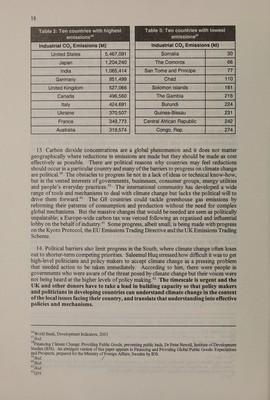
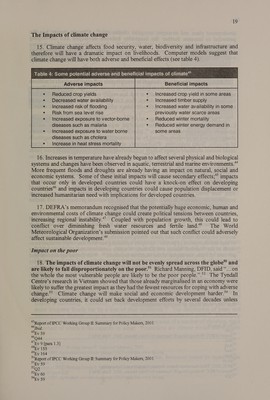
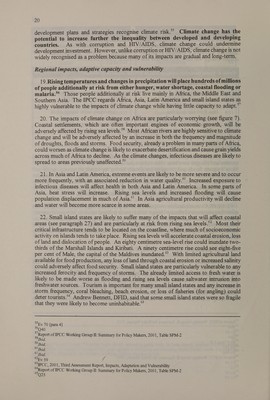
![largely absent from the fora where climate change has been discussed, and more narrowly- focused conservation and scientific agendas have dominated debate. The two international conventions agreed at the ‘Earth Summit’ in Rio, in 1992, both arose from an agenda shaped by northern environmental interests. In Rio, concerns about industrial pollution, smog and acid rain dominated the discussions. But these issues did not necessarily apply to developing countries. In particular, the UNFCCC was closely associated with an environmental agenda that sought to conserve resources and promote environmental sustainability. Developing countries have a different view of climate change to developed countries. They see it not as a problem of pollution or of how to sustain economic growth but as a problem of human welfare that threatens survival itself.”” The politics of climate change 11. Burning fossil fuels, for electricity, heat and transport, is the main source of anthropogenic greenhouse gas emissions, making climate change primarily a consequence of the activities of industrialised countries. Tables 2 and 3 show the huge difference between the ten countries with the highest emissions and the ten with the lowest emissions. The US alone accounts for twenty-four per cent of all current emissions.** According to the Corner House just over 120 corporations account for eighty per cent of all carbon dioxide emissions.” The world’s poor have contributed less than one third of anthropogenic emissions of carbon dioxide and methane and less than twenty per cent of industrial emissions.*° Saleemul Hug, International Institute for Environment and Development (IED), told us that per capita emissions in China and India were many times - smaller than those of developed countries; many, like Bangladesh, had per capita emissions that were negligible compared with the rest of the world.*' Senegal, for example, emitted about thirty kilograms, 160 times less than the US where emissions were nearly five tonnes per head.** However, emissions from developing countries have increased and could increase further as they meet the growing demand for energy and as land use changes. By 2015 emissions from developing countries are likely to exceed those from the developed world.** China, India, and Brazil in particular have seen their emissions grow.** Clare Short recognised that as the economies of developing countries grew they would need to come within the framework for mitigating greenhouse gases.*’ In fact, this is required under the UNFCCC. 12. While past and present generations, mainly in the North, bear responsibility for creating climate change, it is future generations throughout the world who will be most severely affected. The present generation has to begin to bear the costs of finding a solution even though it will see little direct benefit itself. Given their relative contribution, the burden of finding a solution to the problems posed by climate change should fall mainly on developed countries. As the scientific understanding of climate change grows and evidence for the link between anthropogenic emissions and climate change becomes stronger, the issue of liability will come to the fore. We have already suggested that there is a moral liability but at some point the issue of legal liability will have to be considered. >7By 69 >8Ev 129 [para 4.1] Ry 135 EY 143 [paras 2 and 3] 32085 33Ey 6 [para 27] ° ‘Financing Climate Change: Providing Public Goods, preventing public bads, Dr Peter Newell, Institute of Development Studies (IDS). An abridged version of this paper appears in Financing and Providing Global Public Goods: Expectations and Prospects, prepared for the Ministry of Foreign Affairs, Sweden by IDS. Q157](https://iiif.wellcomecollection.org/image/b32221356_0001_0019.jp2/full/800%2C/0/default.jpg)