Volume 1
Global climate change and sustainable development : third report of Session 2001-02 / International Development Committee.
- Great Britain. Parliament. House of Commons. International Development Committee
- Date:
- 2002
Licence: Open Government Licence
Credit: Global climate change and sustainable development : third report of Session 2001-02 / International Development Committee. Source: Wellcome Collection.
36/92 page 34
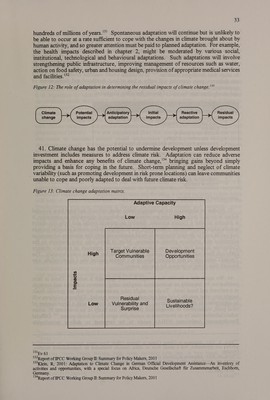
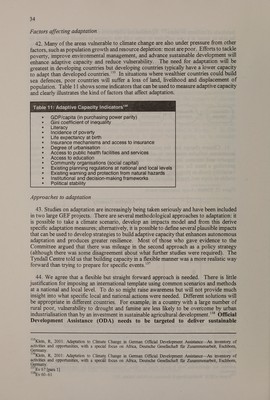
![Factors affecting adaptation 42. Many of the areas vulnerable to climate change are also under pressure from other factors, such as population growth and resource depletion: most are poor. Efforts to tackle poverty, improve environmental management, and advance sustainable development will enhance adaptive capacity and reduce vulnerability. The need for adaptation will be greatest in developing countries but developing countries typically have a lower capacity to adapt than developed countries.'*’ In situations where wealthier countries could build sea defences, poor countries will suffer a loss of land, livelihood and displacement of population. Table 11 shows some indicators that can be used to measure adaptive capacity and clearly illustrates the kind of factors that affect adaptation. SS GDP/capita (in purchasing power parity) Gini coefficient of inequality Literacy Incidence of poverty Life expectancy at birth Insurance mechanisms and access to insurance Degree of urbanisation Access to public health facilities and services Access to education Community organisations (social capital) Existing planning regulations at national and local levels Existing warning and protection from natural hazards Institutional and decision-making frameworks Political stability Approaches to adaptation 43. Studies on adaptation are increasingly being taken seriously and have been included in two large GEF projects. There are several methodological approaches to adaptation: it is possible to take a climate scenario, develop an impacts model and from this derive specific adaptation measures; alternatively, it is possible to define several plausible impacts that can be used to develop strategies to build adaptive capacity that enhances autonomous adaptation and produces greater resilience. Most of those who gave evidence to the Committee argued that there was mileage in the second approach as a policy strategy (although there was some disagreement about what further studies were required). The Tyndall Centre told us that building capacity in a flexible manner was a more realistic way forward than trying to prepare for specific events.'*’ 44. We agree that a flexible but straight forward approach is needed. There is little justification for imposing an international template using common scenarios and methods at a national and local level. To do so might raise awareness but will not provide much insight into what specific local and national actions were needed. Different solutions will be appropriate in different countries. For example, in a country with a large number of rural poor, vulnerability to drought and famine are less likely to be overcome by urban industrialisation than by an investment in sustainable agricultural development.'** Official Development Assistance (ODA) needs to be targeted to deliver sustainable 35k ein, R, 2001: Adaptation to Climate Change in German Official Development Assistance—An inventory of oe and opportunities, with a special focus on Africa, Deutsche Gesellschaft fiir Zusammenarbeit, Eschborn, ermany. *°Kiein, R, 2001: Adaptation to Climate Change in German Official Development Assistance—An inventory of pears and opportunities, with a specidl focus on Africa, Deutsche Gesellschaft fiir Zusammenarbeit, Eschborn, ermany. 'S7Ev 67 [para 1] MSEy 60-61](https://iiif.wellcomecollection.org/image/b32221356_0001_0036.jp2/full/800%2C/0/default.jpg)