Volume 1
Global climate change and sustainable development : third report of Session 2001-02 / International Development Committee.
- Great Britain. Parliament. House of Commons. International Development Committee
- Date:
- 2002
Licence: Open Government Licence
Credit: Global climate change and sustainable development : third report of Session 2001-02 / International Development Committee. Source: Wellcome Collection.
39/92 page 37
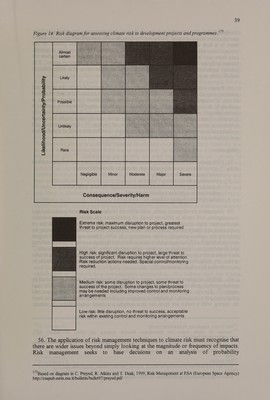
![analysis and planning.'** The institutions must be supported by scientific and technical capacity. 50. With ninety percent of suitable land cultivated in Asia and Europe and seventy-five percent cultivated in North America, climate change will have major implications for farming practice. Africa and South America both have more suitable land left uncultivated than is currently under cultivation. Most of this land is concentrated in just a few countries: Angola, Congo, Sudan, Argentina, Bolivia, Brazil and Colombia.’*’ In many parts of Africa, despite a drop in rainfall and increasing populations, agricultural productivity has been maintained, largely through improved management.'® The FAO is working to help build farmers’ ability to cope with climate change by encouraging ‘no-regrets’ agricultural development and by increasing efficiency and flexibility under current climate conditions so that farmers are better placed to deal with future changes. Their ‘no-regrets’ approach includes reducing the use of nitrogenous fertilisers (which are costly, inefficient and harmful) and making use of breeds of livestock that are efficient converters of feed into milk and meat to reduce methane emissions. They also work with planners to reduce rates of deforestation’®’ as the erosion of forest cover will have implications for watershed management, biodiversity and the use of forest as carbon sinks. Maladaptation 51. Achieving a balance between the tensions inherent in the environment agenda and the development agenda, and between economic liberalisation and sustainable development, presents a difficult challenge. It raises the danger of development actions that do not reduce but increase vulnerability, a process known as maladaptation.'™ Preserving existing resilience and adaptive capacity can help avoid maladaptation. Some adaptation strategies and coping mechanisms are latent and communities may be less vulnerable than models might suggest.'* Donors must take care to ensure that development activity enhances and does not destroy autonomous and latent coping strategies. Maladaptation arises from development that: * occurs in risk prone locations; * is based on short-term considerations; ¢ neglects known climate variability; ¢ suffers from a lack of information; or * is Over-reliant on insurance mechanisms. 52. Jonathan Walter, editor of the World Disasters Report, gave us an example of maladaptation in India where an area of mangrove swamp had been cleared for prawn farming; the mangroves had acted as a break to storm surges and subsequent cyclones destroyed not only the prawn farms but threw many small-holders into destitution.'°* We agree with Neil Adger, Tyndall Centre, that “The first thing that DFID needs to do is make sure that their policies and investments overseas do not actually undermine the capacity to adapt.”.'* Perverse subsidies and large infrastructure projects can undermine adaptive capacity. Without careful assessment and planning, investments in coastal infrastructure, urbanisation, transport and industrialisation could undermine people’s ability to adapt spontaneously.'®° Care has to be taken to ensure that disaster risks 'S8Ey 70 [para 4] and Ev 71 [para 9] '?Food in the 21* Century: Global Climate Disparities, Mahendra Shah, International Institute for Applied Systems Analysis. 160Ry 67 [para 2] 'IEAO, 1997, Agriculture and climate change: FAO’s role See www. fao.org](https://iiif.wellcomecollection.org/image/b32221356_0001_0039.jp2/full/800%2C/0/default.jpg)