Volume 1
Global climate change and sustainable development : third report of Session 2001-02 / International Development Committee.
- Great Britain. Parliament. House of Commons. International Development Committee
- Date:
- 2002
Licence: Open Government Licence
Credit: Global climate change and sustainable development : third report of Session 2001-02 / International Development Committee. Source: Wellcome Collection.
41/92 page 39
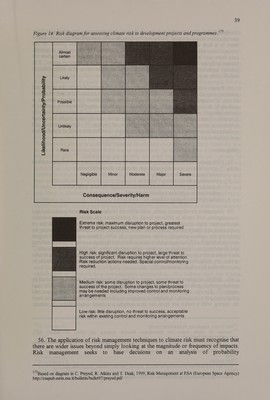
![Figure 14: Risk diagram for assessing climate risk to development projects and programmes!” Almost certain ne’ oy om | Unlikely o We Consequence/Severity/Harm Risk Scale Extreme risk: maximum disruption to project, greatest threat to project success, new plan or process required High risk: significant disruption to project, large threat to success of project. Risk requires higher level of attention. Risk reduction actions needed. Special control/monitoring required. Medium risk: some disruption to project, some threat to success of the project. Some changes to plan/process may be needed including improved control and monitoring arrangements Low risk: little disruption, no threat to success, acceptable risk within existing control and monitoring arrangements 56. The application of risk management techniques to climate risk must recognise that there are wider issues beyond simply looking at the magnitude or frequency of impacts. Risk management seeks to base decisions on an analysis of probability '3ased on diagram in C. Preyssl, R. Atkins and T. Deak, 1999, Risk Management at ESA (European Space Agency) http://esapub.esrin.esa.it/bulletin/bullet97/preyss].pdf](https://iiif.wellcomecollection.org/image/b32221356_0001_0041.jp2/full/800%2C/0/default.jpg)