On the relation of the Westleton Beds, or pebbly sands of Suffolk, to those of Norfolk, and on their extension inland : with some observations on the period of the final elevation and denudation of the Weald and of the Thames Valley, etc. / by Joseph Prestwich.
- Joseph Prestwich
- Date:
- 1890
Licence: Public Domain Mark
Credit: On the relation of the Westleton Beds, or pebbly sands of Suffolk, to those of Norfolk, and on their extension inland : with some observations on the period of the final elevation and denudation of the Weald and of the Thames Valley, etc. / by Joseph Prestwich. Source: Wellcome Collection.
Provider: This material has been provided by The Royal College of Surgeons of England. The original may be consulted at The Royal College of Surgeons of England.
24/118
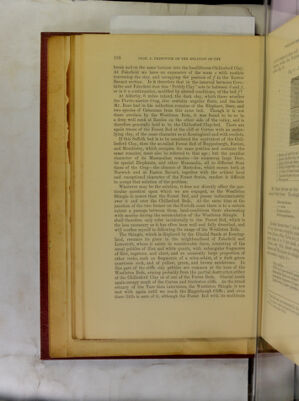
![break and on the same horizon into the fossilifcroua Chillesford Cla}'. At Pakefield we have an expansion of the seam e with rootlets traversing the clay, and occupying the position of f in the Easton Havant section. Is it therefore that in the interval between Cove- hithe and Pakefield that this ‘ Pebbly Clay ’ sets in between d and /, or is it a continuation, modified by altered conditions, of the bed/V At Aldcrby, 0 miles inland, the dark claj’, which there overlies the Eluvio-marine Crag, also contains angular flints, and the late Mr. Rose had in his collection remains of the Elephant, Deer, and two species of Cetaceans from this same bed. Though it is not there overlain by the Westleton Beds, it was found to be so in a deep well sunk at Boccles on the other side of the valley, and is therefore generally held to be the Chillesford Clay-bed. There are again traces of the Forest Bed at the dill’ at Corton with an under- lying clay, of the same character as at Kessiugland and with rootlets. If this Suffolk bed is to be considered the equivalent of the Cliil- lesford Clay, then the so-called Forest Bed of Happisburgh, Buctou, and Mundesley, which occupies the same position and contains the same remains, must also be referred to that age; but the jieculiur character of its ilammalian remains—its numerous largo Deer, its special Elephants, and other Mammalia, all so different from those of the Crag—the absence of Ma.stodon, which occurs both at Norwich and at Easton Bavant, together with the evident local and exceptional character of the Forest Series, renders it difficult to accept that solution of the problem. Whatever may be the solution, it docs not directly affect the par- ticular (juestion upon which we are engaged, as the Westleton Shingle is newer than the Pore.st Bed, and passes indiscriminately over it and over the Chillesford Beds. At the same time at the junction of the two former on the Norfolk coast there is to a certain extent a passage between them, land-conditions there alternating with murine during the accumulation of the Westleton Shingle. I shall therefore only refer incidentally to the Forest Bed, which is the less necessary as it has often been well and fully described, and will confine myself to following the range of the Westleton Beds. The Shingle, which is displaced by the Glacial Sands at Kessing- land, resumes its place in the neighbourhood of Pakefield and Lowestoft, where it exists in considerable force, consisting of the usual pebbles of flint and white quartz, with subangular fragments of flint, ragstone, and chert, and an unusually large proportion of other rocks, sucli as fragments of a mica-schist, of a dark green quartzoso rock, and of yellow, green, and brown sandstones. In this ])art of the cliffs clay pebbles are common at the base of the Westleton Beds, arising probably from the partial destruction either of the Chillesford Clay or of one of the Forest Beds. Glacial sands again occupy much of the Corton and Gorleston cliff's. As the broad estuary of the Yare then intervenes, the Westleton Shingle is not met with again until we reach the Happisburgh Cliff’s; and even there little is seen of it, although the Forest Bed with its multitude](https://iiif.wellcomecollection.org/image/b22446175_0026.jp2/full/800%2C/0/default.jpg)