The dawn of astronomy : a study of the temple-worship and mythology of the ancient Egyptians / by J. Norman Lockyer.
- Norman Lockyer
- Date:
- 1894
Licence: Public Domain Mark
Credit: The dawn of astronomy : a study of the temple-worship and mythology of the ancient Egyptians / by J. Norman Lockyer. Source: Wellcome Collection.
Provider: This material has been provided by the Harvey Cushing/John Hay Whitney Medical Library at Yale University, through the Medical Heritage Library. The original may be consulted at the Harvey Cushing/John Hay Whitney Medical Library at Yale University.
443/476 (page 421)
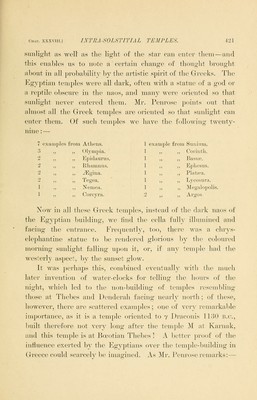
![simlig'lit as well as the light of the star can enter them—and this enables us to note a certain change of thought brought about in all })robability l)y the artistic spirit of the Greeks. The Kgyptian temples were all dark, often with a statue of a god or a reptile obscure in the naos, and many were oriented so that sunlight never entered them. Mr. Penrose points out that almost all the Greek temples are oriented so that sunlight can enter them. Of such temples we have the following twenty- nine : — 7 examples from Athens. example from I Sunium. 3 Olympia. )) Corinth. 2 Epidaurus. 11 Bassa?. 2 Rhamnus. 11 Ephesus. 2 ^o-ina. 11 Platiea. 2 Tegea. 11 Lycosura. 1 Nemea. 11 Megalopolis. 1 Corey ra. 2 11 Argos. Now in all these Greek temples, instead of the dark naos of the Egyptian building, Ave find the cella fully illumined and facing the entrance. Frequently, too, there was a chrys- elephantine statue to be rendered glorious by the coloured morning sunlight falling upon it, or, if any temple had the westerly aspect, by the sunset glow. It was perhaps this, combined eventually vd\\\ the much later invention of water-clocks for telling the hours of the night, which led to the non-building of temples resembling those at Thebes and Denderah facing nearly north; of these, however, there are scattered examples; one of very remarkable importance, as it is a temple oriented to 7 Draconis ll;]!) d.c, built therefore not very long after the temple M at Karnak, and this temple is at Boeotian Thebes ! X better proof of the influence exerted by the Egyptians over the temple-building in Greece could scarcely be imagined. As Mr. Penrose remarks: —](https://iiif.wellcomecollection.org/image/b21015557_0443.jp2/full/800%2C/0/default.jpg)