Licence: Public Domain Mark
Credit: Clinical medicine : cases / by Dr. M'Call Anderson. Source: Wellcome Collection.
Provider: This material has been provided by The University of Glasgow Library. The original may be consulted at The University of Glasgow Library.
16/16 page 16
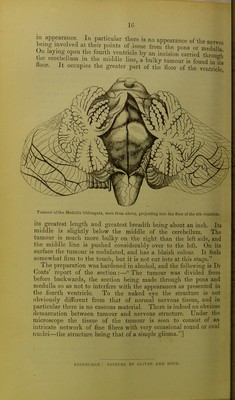
![IG in appearance^ In particular there is no appearance of the nerves being mvolved at their points of.issue from the pons or mMh On laying open the fourth ventricle by an incision carried tluZh the cerebellum m the middle Ime, a bulky tumour is found in floor. It occupies the greater part of the floor of the ventricle, Tumour of the Medulla Oblongata, seen from above, projecting into the floor of the 4th ventricle. its greatest length and greatest breadth being about an inch. Its middle is slightly below the middle of the cerebellum. The tumour is much more bulky on the right than the left side, and tlie middle line is pushed considerably over to the left. On its surface the tumour is nodulated, and has a bluish colour. It feels somewhat firm to the touch, but it is not cut into at this stage. The preparation was hardened in alcohol, and the following is Dr Coats' report of the section:— The tumour was divided from before backwards, the section being made through the pons and medulla so as not to interfere with the appearances as presented in the fourth ventricle. To the naked eye the structure is not obviously different from that of normal nervous tissue, and in particular there is no caseous material. There is indeed no obvious demarcation between tumour and nervous structure. Under the microscope the tissue of the tumour is seen to consist of an intricate network of fine fibres with very occasional round or oval nuclei—the structure being that of a simple glioma.] ElUNmiUGH : PIIINTBD BY OMVKR AND BOYa](https://iiif.wellcomecollection.org/image/b21457554_0018.jp2/full/800%2C/0/default.jpg)