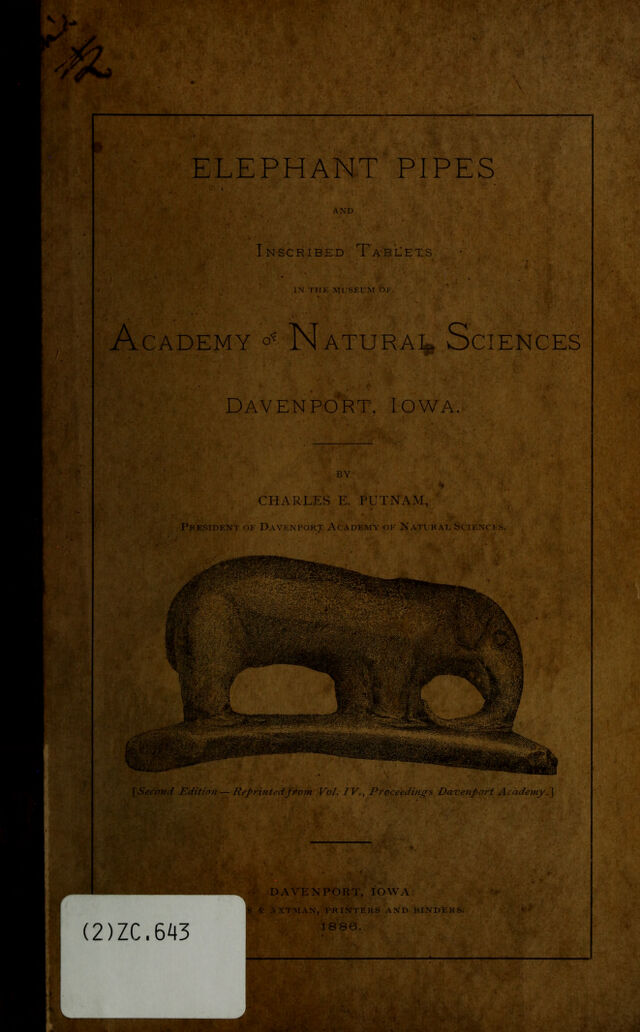
Elephant pipes and inscribed tablets in the Museum of the Academy of natural sciences, Daveport, Iowa / by Charles E. Putnam.
- Charles Edwin Putnam
- Date:
- 1885
Licence: Public Domain Mark
Credit: Elephant pipes and inscribed tablets in the Museum of the Academy of natural sciences, Daveport, Iowa / by Charles E. Putnam. Source: Wellcome Collection.
10/100 page 8
![the Davenport Academy of Natural Sciences. In this bitter assault Mr. Henshaw is ably supported by the strong endorsement of Major J. W. Powell, the Director of the Bureau. The Smithsonian Institu- tion occupies a commanding position in the world of scienceand, inasmuch as it has given special attention to researches in archaeology, it may properly be considered entitled to speak with authority upon these questions. Its sharp criticism, therefore, presents to our Acad- emy a conspicuous opportunity for a careful review of the circum- stances, and a plain restatement of the facts establishing, beyond rea- sonable doubt, the genuineness of its valuable discoveries. In the line of archaeology the Davenport Academy has attained deserved eminence. Its inscribed tablets, elephant pipes, cloth-cov- ered copper axes, and rare collection of ancient pottery have attracted the attention of archmologists throughout the world of science. These remarkable relics, received with enthusiasm by antiquarians, are gener- ally accepted as authentic additions to the “unwritten history” of the past. That discoveries so rare and unique should be subjected to severe scrutiny might reasonably be expected; and, when exercised in the spirit of an earnest quest of truth, it was even to be desired. Dis- coveries which are to become the foundations for important historical deductions should be securely intrenched, beyond the reach of adverse criticism, on the bed-rock of truth. These valuable contributions to the science of archaeology have undoubtedly given the Davenport Academy a conspicuous position. The assumed fact, emphasized by Mr. Henshaw, that “it has fallen to the good fortune of no one else to find anything conveying the most distant suggestion of the mastodon,” is found to be even embarrassing, inasmuch as it places our Academy in the range of fire between contending archaeologists. It is certainly a misfortune of the Davenport Academy that the museum of the Smith- sonian Institution contains neither elephant pipes nor inscribed tablets. The discoveries in question are two elephant pipes and three in- scribed tablets. Of the latter, the first two were found in what is known as Mound No. 3, on the Cook farm, adjoining the city of Dav- enport. The principal discoverer was Rev. Jacob Gass, a Lutheran clergyman, then settled over a congregation in Davenport. In this exploration Mr. Cxass was assisted by L. H. Willrodt and H. S. Stoltz- enau, with five other persons who were accidentally present during the opening of the mound. The discovery was made on January loth, 1877. An exact and careful statement of the facts connected therewith was soon after ])repared by Rev. Mr. Gass, and read at an early meeting](https://iiif.wellcomecollection.org/image/b24863087_0010.jp2/full/800%2C/0/default.jpg)


 No text description is available for this image
 No text description is available for this image
 No text description is available for this image