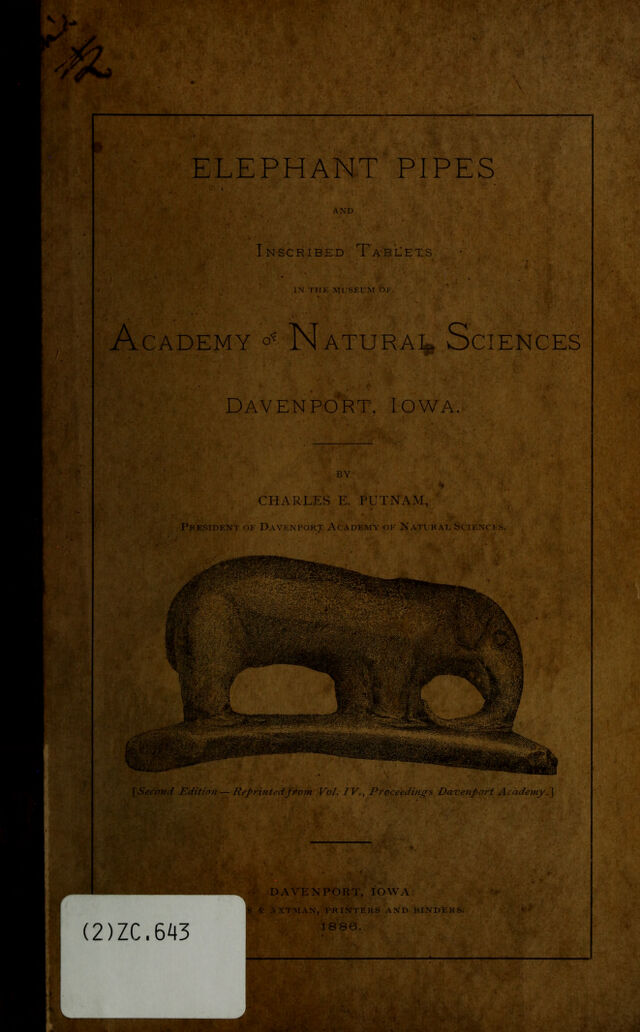
Elephant pipes and inscribed tablets in the Museum of the Academy of natural sciences, Daveport, Iowa / by Charles E. Putnam.
- Charles Edwin Putnam
- Date:
- 1885
Licence: Public Domain Mark
Credit: Elephant pipes and inscribed tablets in the Museum of the Academy of natural sciences, Daveport, Iowa / by Charles E. Putnam. Source: Wellcome Collection.
16/100 page 14
![domain of science. Every essential circumstance was carefully noted — the location of the relics, the condition of the surrounding soil, the evidence of undisturbed strata. The explorers were only embarrassed by the extraordinary character of their discoveries, and were fortunate in being able to furnish for these “unusual relics” that “positive proof” demanded by Mr. Bancroft’s rigid rule. ddiis rapid review will serve, in some measure, to recall the circum- stances surrounding the discoveries in question, and in a slight degree to indicate their great scientific value. If their authenticity is estab- lished, then archaeologists will find in them strong corroborative evi- dence that man and the mastodon were contemporary on this conti- nent, and that the Mound-builders were a-race anterior to the ances- tors of the present American Indians, and of higher type and more advanced civilization. As this conclusion would conflict with the theory announced by the Bureau of Ethnology, Mr. Henshaw was compelled to discredit these important discoveries.'^ Before his “destructive criticism” the characters of men and the verities of science must alike be swept away to make room for a favorite theory. It was doubtless unfortunate for the Davenport Academy that its remarkable discoveries impeded the progress of this knight-errant of science ;t but if its elephant pipes and inscribed tablets were authentic and genuine, then his favorite theory would seem to be at fault. He does not hesitate, therefore, to throw discredit upon these relics, to assail the honesty of the discoverer, and to impale with his scathing censure the institution that published them to the world. It is, there- fore, full time for a calm and thorough review of all the circumstances surrounding these discoveries, with the view of finally disposing of all questions as to their authenticity. That we may not in the slightest degree misrepresent the Bureau of * We must not be understood to condemn all “theory ” as without use in scientific research. We only condemn its abuse. It must be conceded that theory is a tireless pioneer of prof^-ress, and has inspired many a g-reat worker in science to follow its lig'ht into vast unknown seas, until, as with Columbus, a new continent has dawned upon his vision. Let archaeologists therefore, if they ])lease, weave their “theories” out of the very gossamers of thought, if so he it induce them to delve more industriously in earth-work and mound for their “facts.” In the dawning light the unsubstantial theory may melt away, but the ultimate facts will remain, an imperishahle possession. f The appellation in the text is not undeserved. Mr. Henshaw jiresents an “illustration” of a tailless elephant which is itself a fraud; he then assumes that all the relics in question were the “finds” of “one individual,” which is false. Having thus conjured through his imagina- tion this unreal state of “facts,” he then triumphantly proceeds to demolish it. For a parallel to this performance we must resort to fiction. We shall find its analogue in the memorable tilt of the valorous Knight of La Mancha with the unoft'ending windmills!](https://iiif.wellcomecollection.org/image/b24863087_0016.jp2/full/800%2C/0/default.jpg)




 No text description is available for this image
 No text description is available for this image
 No text description is available for this image