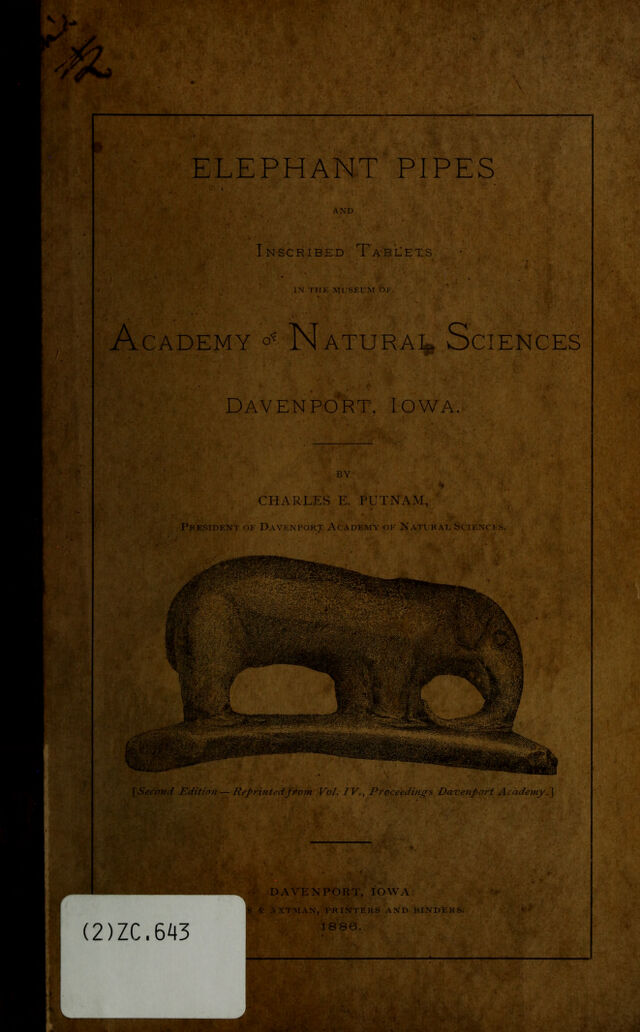
Elephant pipes and inscribed tablets in the Museum of the Academy of natural sciences, Daveport, Iowa / by Charles E. Putnam.
- Charles Edwin Putnam
- Date:
- 1885
Licence: Public Domain Mark
Credit: Elephant pipes and inscribed tablets in the Museum of the Academy of natural sciences, Daveport, Iowa / by Charles E. Putnam. Source: Wellcome Collection.
22/100 page 20
![presumably the work of other hands, should so closely copy the imperfections of that mound.” * The accuracy of the foregoing representations can easily be verified by comparison with the photographs of these pipes in possession of the Smithsonian Institution. As will be seen by “a glance” at the above rep- resentations, the “tail” is therein clearly “indicated,*’ and Mr. Henshaw’s tiimsy argument is, therefore, left without foundation, and he stands con- victed of an inexcusable blunder. This ludicrous mistake on the part of Mr. Henshaw clearly reveals the culpable carelessness of his scien- tific methods.t It will be found, moreover, upon careful examination, that the differences between the Wisconsin mound and the elephant pipes are more numerous than their resemblances — the full-length pro- boscis and the tail, ears, eyes, and mouth all being fully represented in the pij)es and wanting in the mouhd; and hence, in the one point of similarity, from the absence of tusks, there is no sufficient basis for his argument. To enable the reader to make comparison of these ele- ]jhant ))ipes with this Wisconsin mound, an illustration of the latter is here given. J Fig. 3.-—Big Elephant Mound in Grant County, Wisconsin. 'Fhe absence of “ivory” relics in the mounds is also urged by Mr. Henshaw to strengthen his argument. A sufficient explanation of this circumstance will be found in the accepted hypothesis that at the era * Second Annual Report Bureau of Ethnolog-y, 1SS0-81, p. 156. j Mr. Henshaw manifests zeal in the exposure of deceptions, and yet the very representa- tions of our elephant pipes employed by him to embellish his paper are themselves archasoloffical “ fr.Tuds ” of singular enormity; and as the unfortunate citizen found with the kit of a counter- feiter in his grip-sack is required by the law to justify his possession, so Mr. Henshaw may prop- erly be called upon to explain the orig-in of these “tailless” illustrations. The curious reader who will compare them with the true representations, as found in the Academy Proceedings, or even in the recent work of Nadaillac, will find himSelf in “serious doubt” whether Mr. Hen- shaw’s argument was framed to fit his fancy illustrations, or the illustrations were designed to support his argument. ^ For this illustration we are indebted to the courtesy of Mr. Edward P. Vining, author of “An Inglorious Columbus.”](https://iiif.wellcomecollection.org/image/b24863087_0022.jp2/full/800%2C/0/default.jpg)