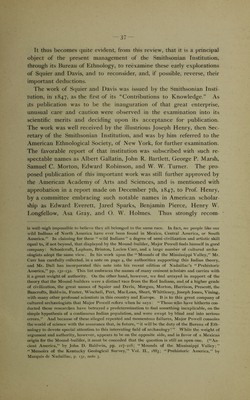
Elephant pipes and inscribed tablets in the Museum of the Academy of natural sciences, Daveport, Iowa / by Charles E. Putnam.
- Charles Edwin Putnam
- Date:
- 1885
Licence: Public Domain Mark
Credit: Elephant pipes and inscribed tablets in the Museum of the Academy of natural sciences, Daveport, Iowa / by Charles E. Putnam. Source: Wellcome Collection.
40/100 (page 38)
![mended, the work of Squier and Davis made its appearance under the auspices of the Smithsonian Institution.It was everywhere well re- ceived. Since that date it has been the principal authority in Ameri- can archaeology, and the most considerable storehouse of ethnological information. It has given direction to a generation of scientific work- ers. Its important deductions have permeated the thought of the best scholars and most ])rofound thinkers throughout our own and foreign lands, t Linder a new management, the Smithsonian Institution has under- taken to reconsider this great work of Squier and Davis, and aims to refute its important deductions. It seems to have been recently dis- covered that in its publication that institution has not been engaged in the “diffusion of knowledge” at all, but instead, during all these years, has been scattering error broadcast through the land. We are, there- fore, called upon to retrace our steps, to unlearn the lesson we have so long conned, and to take our places at the feet of strange teachers. This is certainly discouraging to American scholarship, and the thought- ful student will wisely pause and make careful inquiry as to which, after all, is error — the earlier or the later deductions. Still, it must be conceded, if the statements of the great work of Squier and Davis are unreliable, and its deductions without sufficient basis, these defects cannot be too early disclosed to the world of science. Such an exposure would be a benefaction to the cause of truth. The attempt to reverse the thought of an age is, however, a most notable undertaking. It needs great courage, excellent schol- arship, and a commanding name. It will, of course, be taken for granted that the man called to so important a work must have been long engaged in arclijeological research, trained in its methods of in- vestigation, and familiar with its literature. We recall the names of noted archaeologists, and wonder who among them would have the temerity to engage in this gigantic undertaking. In response to our summons none such appear; but, instead, the Director of the Bureau steps promptly to the front and makes due announcement of “Henry * Eighth Annual Report Smithsonian Institution, j)p. 133-147. T It is reasonable to conclude that Professor Baird, of the Smithsonian Institution, never saw the paper of Mr. Ilenshaw previous to its publication. Had it been subjected to the scrutiny of this eminent and profound scholar, its careless statements and loose deductions would assuredly have met his condemnation and prevented its unfortunate publication. The Secretary of the Smithsonian Institution will doubtless find it necessary to exercise a more careful supervision over the publications of the Bureau of Ethnology, and to subject them to somewhat of that severe scr\itiny employed when the valuable work of Squier and Davis was accepted for publication.](https://iiif.wellcomecollection.org/image/b24863087_0040.jp2/full/800%2C/0/default.jpg)