Researches on diamagnetism and magne-crystallic action : including the question of diamagnetic polarity / by John Tyndall.
- John Tyndall
- Date:
- 1870
Licence: Public Domain Mark
Credit: Researches on diamagnetism and magne-crystallic action : including the question of diamagnetic polarity / by John Tyndall. Source: Wellcome Collection.
Provider: This material has been provided by the Francis A. Countway Library of Medicine, through the Medical Heritage Library. The original may be consulted at the Francis A. Countway Library of Medicine, Harvard Medical School.
345/436 (page 303)
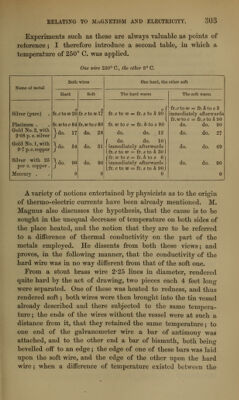
![Experiments such as these are always valuable as points of reference; I therefore introduce a second table, in which a temperature of 250° C. was applied. One wire 250° C, the other 8° C. Both wires One hard, the other soft Name of metal Hard Soft The hard warm The soft warm o o of fr. c to w = fr.Atos3 Silver (pure) fr. c to w20 fr.cto«;17 fr. c to w «= fr. s to h 90 \ immediately afterwards I fr. w to c = fr.sto A 90 Platinum . fr. w to c84 fr. w to i •80 fr. w to c = fr. h to s 90 do. do. 90 Gold No. 2, with 2*08 p. c. silver jdo. 17 do. 28 do. do. 12 do. do. 27 Gold No. 1, with 9-7 p.c. copper jdo. 54 do. 31 ( do. do. 10] ■j immediately afterwards \ (fr.ctow = fr. sto h 30 j (fr. w to c — fr. h to s 6 ] do. do. G9 Silver with 25 1 do. 90 do. 90 \ immediately afterwards \ do. do. 90 per c. copper. (fr. c to w = fr. s to h 90 j Mercury . 0 0 0 0 A variety of notions entertained by physicists as to the origin of thermo-electric currents have been already mentioned. M. Magnus also discusses the hypothesis, that the cause is to be sought in the unequal decrease of temperature on both sides of the place heated, and the notion that they are to be referred to a difference of thermal conductivity on the part of the metals employed. He dissents from both these views; and proves, in the following manner, that the conductivity of the hard wire was in no way different from that of the soft one. From a stout brass wire 2*25 lines in diameter, rendered quite hard by the act of drawing, two pieces each 4 feet lon<^ were separated. One of these was heated to redness, and thus rendered soft; both wires were then brought into the tin vessel already described and there subjected to the same tempera- ture ; the ends of the wires without the vessel were at such a distance from it, that they retained the same temperature; to one end of the galvanometer wire a bar of antimony was attached, and to the other end a bar of bismuth, both beino- bevelled off to an edge; the edge of one of these bars was laid upon the soft wire, and the edge of the other upon the hard wire ; when a difference of temperature existed between the](https://iiif.wellcomecollection.org/image/b21167096_0345.jp2/full/800%2C/0/default.jpg)