Researches on diamagnetism and magne-crystallic action : including the question of diamagnetic polarity / by John Tyndall.
- John Tyndall
- Date:
- 1870
Licence: Public Domain Mark
Credit: Researches on diamagnetism and magne-crystallic action : including the question of diamagnetic polarity / by John Tyndall. Source: Wellcome Collection.
Provider: This material has been provided by the Francis A. Countway Library of Medicine, through the Medical Heritage Library. The original may be consulted at the Francis A. Countway Library of Medicine, Harvard Medical School.
376/436 (page 332)
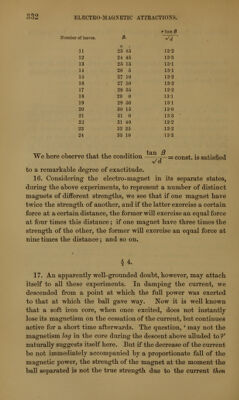
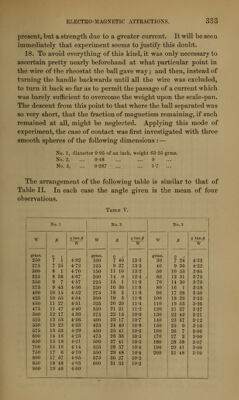
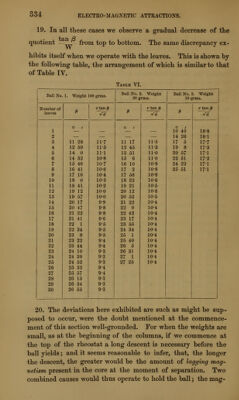
![r tan $ Number of leaves. t 1. Vd ' 11 o 23 45 13'2 12 24 45 13-3 13 25 15 13-1 14 26 5 13-1 15 27 10 13-2 16 27 50 132 17 28 35 132 18 29 0 131 19 29 50 131 20 30 15 130 21 31 0 133 22 31 40 132 23 32 25 13-2 24 33 10 13-3 observe that t] ie con iitioi tan 0 1 :——n — const, is satisfied to a remarkable degree of exactitude. 16. Considering the electro-magnet in its separate states, during the above experiments, to represent a number of distinct magnets of different strengths, we see that if one magnet have twice the strength of another, and if the latter exercise a certain force at a certain distance, the former will exercise an equal force at four times this distance ; if one magnet have three times the strength of the other, the former will exercise an equal force at nine times the distance; and so on. §4. 17. An apparently well-grounded doubt, however, may attach itself to all these experiments. In damping the current, we descended from a point at which the full power was exerted to that at which the ball gave way. Now it is well known that a soft iron core, when once excited, does not instantly lose its magnetism on the cessation of the current, but continues active for a short time afterwards. The question, ' may not the magnetism lag in the core during the descent above alluded to ?' naturally suggests itself here. But if the decrease of the current be not immediately accompanied by a proportionate fall of the magnetic power, the strength of the magnet at the moment the ball separated is not the true strength due to the current then](https://iiif.wellcomecollection.org/image/b21167096_0376.jp2/full/800%2C/0/default.jpg)