Hand-book of calisthenics and gymnastics : a complete drill-book for schools, families, and gymnasiums : with music to accompany the exercises / by J. Madison Watson.
- J. Madison Watson
- Date:
- 1864
Licence: Public Domain Mark
Credit: Hand-book of calisthenics and gymnastics : a complete drill-book for schools, families, and gymnasiums : with music to accompany the exercises / by J. Madison Watson. Source: Wellcome Collection.
Provider: This material has been provided by the Francis A. Countway Library of Medicine, through the Medical Heritage Library. The original may be consulted at the Francis A. Countway Library of Medicine, Harvard Medical School.
43/410 page 35
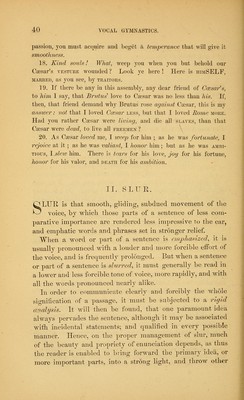
![The mark of acute accent ['] is employed, ^rs^, to indicate primary accent; secondly, the rising inflection (p. 44); as, Reading, or reading. If thine enemy hunger', give him bread. The mark of grave accent [v] is employed, first, to indi- cate secondary accent; secondly, that the vowel over which it is placed, with its attendant consonant, forms a separate syllable; thirdly, that the vowel in the unaccented syllable is not an alphabetic equivalent, but represents one of its usual oral elements; and fourthly, the falling inflection (p. 44); as, Magnificent, or magmificent. A learned man caught that winged thing. Her goodness moved the roughest. Away\ thou cowardv! The student will be required to give the office of each mark in the following Examples. 1. Veracity first of all, and forever. 2. The finest wits have their sediment. 3. Hunting ??ien\ not beasts', shall be his game. 4. Honest students learn the greatness of humility. 5. A foolx with judges'; among fools', a judge\ 6. Costume, manners, riches, civilization, have no permanent in- terest for him.—His heedlessness offends his truest friends. T. In a crowded life, on a stage of nations, or in the obscurest hamlet, the same blessed elements offer the same rich choices to each new comer. WORDS DISTINGUISHED BY ACCENT. Many words, or parts of speech, having the same form, are distinguished by accent alone. Nouns and adjectives are often thus distinguished from verbs. Examples. 1. AVhy does your ab'sent friend absent' himself? 2. Did he abstract' an ab'stract of your speech from the desk ? 3. Note the mark of ac'cent, and accent' the right syllable.](https://iiif.wellcomecollection.org/image/b21083514_0043.jp2/full/800%2C/0/default.jpg)


 No text description is available for this image
 No text description is available for this image
 No text description is available for this image