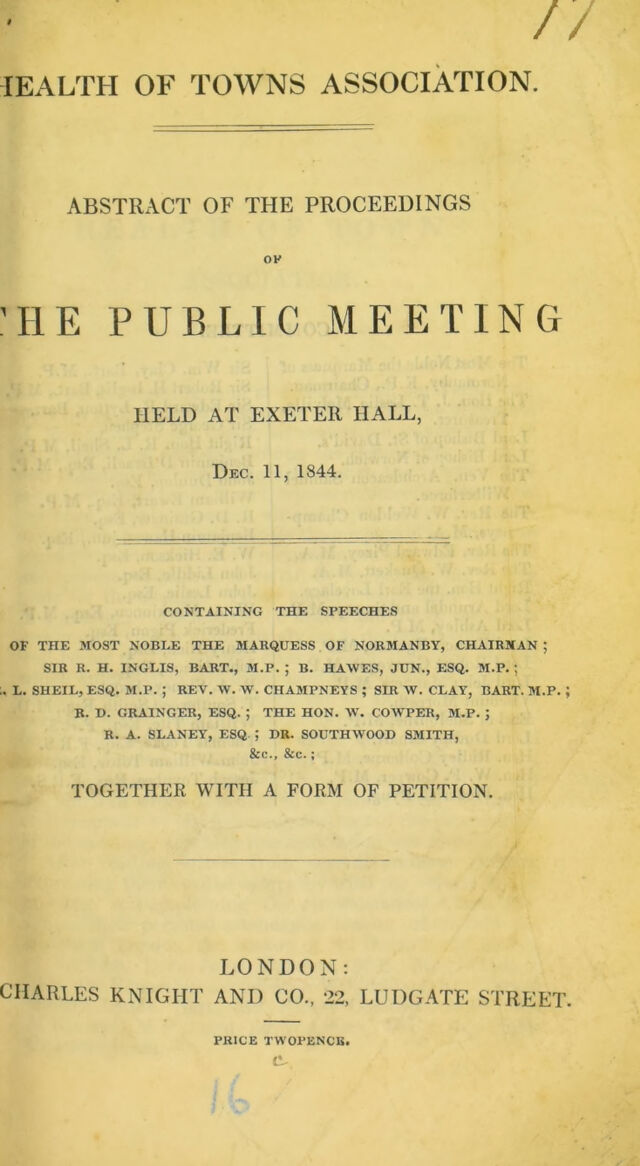
Abstract of the proceedings of the public meeting held at Exeter Hall, Dec. 11, 1844 : containing the speeches of the most noble the Marquess of Normanby, chairman ... together with a form of petition.
- Health of Towns Association (London, England)
- Date:
- [1844?]
Licence: Public Domain Mark
Credit: Abstract of the proceedings of the public meeting held at Exeter Hall, Dec. 11, 1844 : containing the speeches of the most noble the Marquess of Normanby, chairman ... together with a form of petition. Source: Wellcome Collection.
Provider: This material has been provided by The University of Glasgow Library. The original may be consulted at The University of Glasgow Library.
24/36 page 24
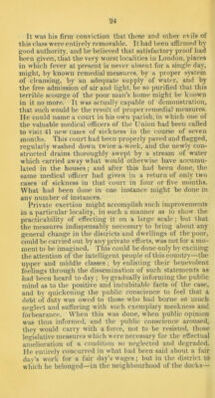
![It was his firm conviction that these and other evils of this class were entirely removable. It had been affirmed by j^ood authority, and he believed that satisfactory proof had been given, that the very worst localities in London, places in which fever at present is never absent for a single day, might, by known remedial measures, by a proper system of cleansing, by an adequate supply of water, and by the free admission of air and light, be so purified that this terrible scourge of the poor man’s home might be known in it no more. It was actually capable of demonstration, that such would be the result of proper remedial measures. He could name a court in his own parish, in which one of the valuable medical officers of the Union had been called to visit 41 new cases of sickness in the course of seven months. This court had been properly paved and flagged, regularly washed down twice a-week, and the newly con- structed drains thoroughly swept by a stream of water w'hich carried away what would otherwise have accumu- lated in the houses; and after this had been done, the same medical officer had given in a return of only two cases of sickness in that courr in four or five months. What had been done in one instance might be done in any number of instances. Private exertion might accomplish such improvements in a particular locality, in such a manner as to show the practicability of effecting it on a large scale; but that the measures indispensably necessary to bring about any general change in the districts and dwellings of the poor, could be carried out by any private efforts, was not for a mo- ment to be imagined. This could be done only by e.xciting the attention of the iutelligent people of this country—the upper and middle classes; by enlisting their benevolent feelings through the dissemination of such statements as had been heard to-day; by gradually informing the i)ublic mind as to the positive and indubitable facts of the case, and by quickening the public conscience to feel that a debt of duty was owed to those who had borne so much neglect and suffering with siich exemplary meekness and forbearance. When this was done, when public opinion was thus informed, and the ]niblic conscience aroused, they would carry with a force, not to be resisted, those legislative measures which u ere necessary for the effectual amelioration of a condition so neglected and degraded. He entirely concurred in what had been said about a fair dav’s work for a fair day’s wages; but in the district to which he belonged—in the neighbourhood of the docks —](https://iiif.wellcomecollection.org/image/b24931615_0026.jp2/full/800%2C/0/default.jpg)