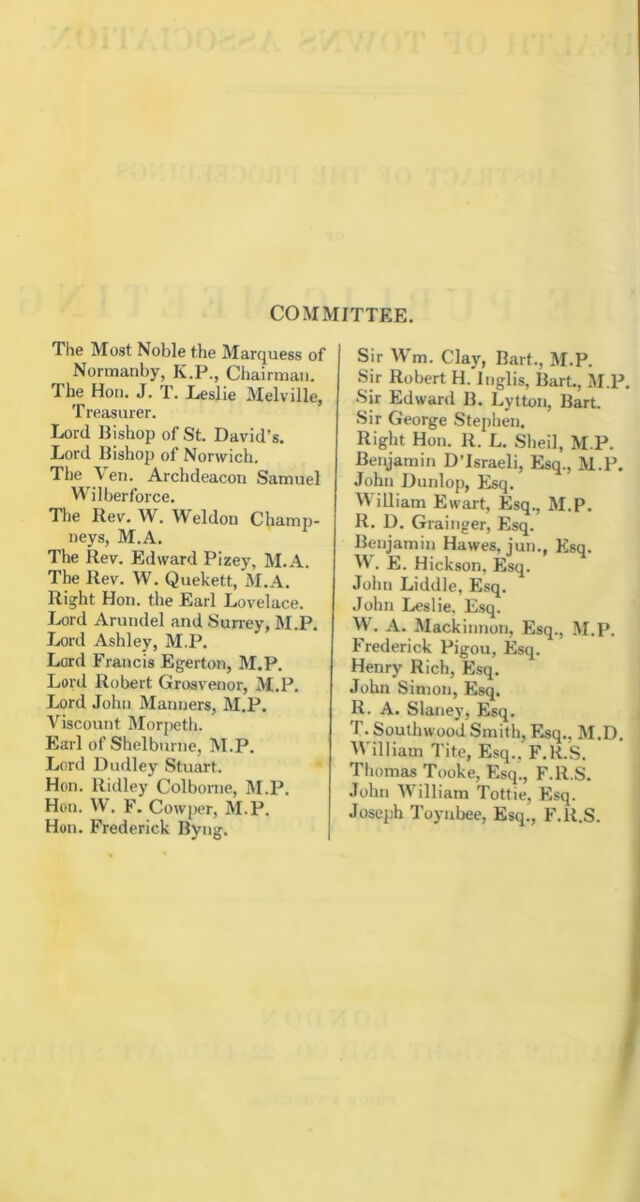
Abstract of the proceedings of the public meeting held at Exeter Hall, Dec. 11, 1844 : containing the speeches of the most noble the Marquess of Normanby, chairman ... together with a form of petition.
- Health of Towns Association (London, England)
- Date:
- [1844?]
Licence: Public Domain Mark
Credit: Abstract of the proceedings of the public meeting held at Exeter Hall, Dec. 11, 1844 : containing the speeches of the most noble the Marquess of Normanby, chairman ... together with a form of petition. Source: Wellcome Collection.
Provider: This material has been provided by The University of Glasgow Library. The original may be consulted at The University of Glasgow Library.
4/36 page 4
![Although the object which they had now assembled to promote was one which had met with the most remarkable concurrence of opinion from men of all parties, no attempt had hitherto been made to combine their efforts, so as to give a practical effect to those opinions; yet the health of the people was the one thing in the promotion of which all might co-operate, whatever in other respects their adverse theories, social and political. Even an autocrat, if wise, and an enlightened patriot, might here meet on common ground ; for the despot who looks upon his fellow men as machines to extend his own power, and the ])hilan- thropist who regards the sorrows of others as his own, must both attach the first importance, for the realization of the virtuous wishes of the one, and the ambitious pro- jects of the other, to the physical well-being, the health and strength of the people amongst whom they live. How then did it happen that such a state of things as was exhibited in the reports recently laid before the legislature had been permitted to grow up ? His own attention had been first fixed upon the subject in con- sequence of particular opjjortunities for observing the details which had occurred to him during the time he had had the honour to hold a high public office. But from that time he had never felt more strongly than at the ])re- sent moment the conviction, not only that nothing had been done to remove these terrible evils, but that they were actually in a state of daily im^reasing virulence ; and taken, as they must be, in connexion with other circum- stances in the social condition of the poorer orders, they gave room for a well-grounded anxiety for the permanence of our national greatness. The most striking instances of the deterioration of physical strength rvere to be found in the districts where the greatest social changes had taken place within the last thirty years—where the invest- ment of capital and the development of mechanical dis- coveries had collected a large po})ulation together, without an attempt being made to secure their physical well-being. But yet there is scarcely a district exempted from some share in the charge of such neglect. If they turned their glance upon the metropolis, it was not the busy east alone which was obnoxious to it, for in the neighbourhood of the well-ventilated squares of the w est there were dense courts and alleys containing within themselves the seeds of disease germinating there, ready to spread their baleful influence around. All this was disgraceful and dangerous. Since the last session of Parliament he had studied the](https://iiif.wellcomecollection.org/image/b24931615_0006.jp2/full/800%2C/0/default.jpg)