A contribution to the climatological study of phthisis in Pennsylvania.
- William Pepper
- Date:
- 1887
Licence: Public Domain Mark
Credit: A contribution to the climatological study of phthisis in Pennsylvania. Source: Wellcome Collection.
Provider: This material has been provided by Royal College of Physicians, London. The original may be consulted at Royal College of Physicians, London.
60/96 page 46
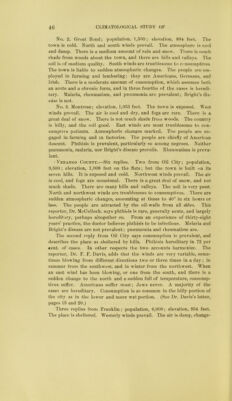
![No. 2. Great Bend; population. 1,500; elevation, 884 feet. The town is cold. North and south winds prevail. The atmosphere is cool and damp. There is a medium amount of rain and snow. Tfiere is much shade from woods about the town, and there are hills and valleys. The soil is of medium quality. South winds are troublesome to cinsumptives. The town is liable to sudden atmospheric changes. The people are em- ployed in farming and lumbering; they are Americans, Germans, and Irish. There is a moderate amount of consumption, which assumes both an acute and a chronic form, and in three fourths of the cases is heredi- tary. Malaria, rheumatism, and pneumonia are prevalent; Bright’s dis- ease is not. No. 3. Montrose; elevation, 1,053 feet. The town is exposed. West winds prevail. The air is cool and dry, and fogs are rare. There is a great deal of snow. There is not much shade from woods. The country is hilly, and the soil good. East winds are most troublesome to con- sumptive patients. Atmospheric changes marked. Tlie people are en- gaged in farming and in factories. The people are chiefly of Amei-ican descent. Phthisis is prevalent, particularly .‘so among negroes. Neither pneumonia, malaria, nor Bright’s disease prevails. Rheumatism is preva- lent. Venango County.—Six replies. Two from Oil City; population, 9,500; elevation, 1,008 feet on the flats; but the town is built on its seven hills. It is exposed and cold. Northwest winds prevail. The air is cool, and fogs are occasional. There is a great deal of snow, and not much shade. There are many hills and valleys. The soil is very poor. North and northwest winds are troublesome to consumptives. There are sudden atmospheric changes, amounting at times to 40° in six hours or leas. The ]>eople are attracted by the oil-wells from all sides. This reporter. Dr. McCulloch, says phthRis is rare, generally acute, and largely heredit.iry, perhaps altogether so. From an experience of thirty-eight years’ practice, the doctor believes phthisis to be infectious. Malaria and Bright’s disease are not prevalent; pneumonia and rheumatism are. The second reply from Oil City says consumption is prevalent, and describes the place as sheltered by hills. Phthisis hereditary in 72 per «ent. of cases. In other respects the two accounts harmonize. The reporter. Dr, F. F. Davis, adds that the winds are very variable, some- times blowing from difterent directions two or three times in a day; in summer from the southwest, and in winter from the northwest. When an east wind has been blowing, or one from the south, and there is a sudden change to the north and a sudden fall of temperature, consump- tives suffer. Americans sulTer most; Jews never. A majority of the cases are hereditary. Consumption is as common in the hilly portion of the city as in the lower and more wet portion. (See Dr. Davis’s letter, pages 15 and 20.) Three replies from Franklin; population, 6,000; elevation, 954 feet. The place is sheltered. Westerly winds prevail. The air is damp, change-](https://iiif.wellcomecollection.org/image/b28270538_0062.jp2/full/800%2C/0/default.jpg)