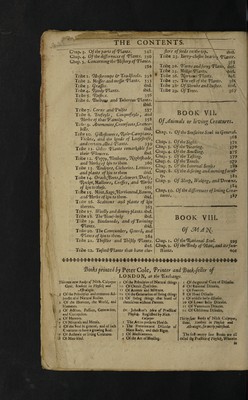
Thirteen books of natural philosophy: viz. I. Of the principles, and common adjuncts of all natural bodies. II. Of the heavens, the world, and elements. III. Of action, passion, generation, and corruption. IV. Of meteors. V. Of minerals and metals. VI. Of the soul in general, and of things vegetable. VII. Of animals or living creatures. VIII. Of man. Unto which is added five books more of natural philosophy in several discourses. IX. Discourse I. Of the principles of natural things. X. Dis. 2. Concerning the occult and hidden qualities. XI. Dis. 3. Of atomes and mixture. XII. Dis. 4. Of the generation of live things. XIII. Dis. 5. Concerning the spontaneous generation of live things / Written in Latin and English. By Daniel Sennert, doctor of physick, [tr. by] Nicholas Culpeper, physitian and astrologer,, Abdiah Cole, doctor of physick, and the liberal arts [and William Rowland?].
- Daniel Sennert
- Date:
- 1661
Licence: Public Domain Mark
Credit: Thirteen books of natural philosophy: viz. I. Of the principles, and common adjuncts of all natural bodies. II. Of the heavens, the world, and elements. III. Of action, passion, generation, and corruption. IV. Of meteors. V. Of minerals and metals. VI. Of the soul in general, and of things vegetable. VII. Of animals or living creatures. VIII. Of man. Unto which is added five books more of natural philosophy in several discourses. IX. Discourse I. Of the principles of natural things. X. Dis. 2. Concerning the occult and hidden qualities. XI. Dis. 3. Of atomes and mixture. XII. Dis. 4. Of the generation of live things. XIII. Dis. 5. Concerning the spontaneous generation of live things / Written in Latin and English. By Daniel Sennert, doctor of physick, [tr. by] Nicholas Culpeper, physitian and astrologer,, Abdiah Cole, doctor of physick, and the liberal arts [and William Rowland?]. Source: Wellcome Collection.
![thefe things 5 but that this manner of the generation ot Natural things which never was in Nature, nor ever will be, is obtruded upon U3 like an Oracle, fo that he which does not admit and reverence the fame, he mult be faid tooverthrow the Principles of Nature, to be an Inventer of new Para¬ doxes, abfurd 5 and that there may be no want of Calumnies and lyes, he muft be a Blafpheraer and an Heretick. If moreover you fliall demand what is that fame venerable Antiquity, of the contempt whereof he fo com¬ plains 5 the greateft Ariitoteleans wil ingenuoufly confefs, that they have never as yet been able to find thofe Principles, and fuch an Edu&ion of forms out of the aptitude of the mattery and therefbre fome wil anfwer that they mud be afcribed to Averroes, others not to him neither, fince pla¬ ces contrary thereto are found in him, but to the School-men. Thefe (for- footh) are the eternally true Principles of reverend Antiquity; this the Confent of venerable Antiquity. But let us (truly) fuppofe that Arifiotle either invented or published them $ yet is not Arifiotle (let me fay with his good leave whom 1 admire and reverence as a great Philofopher) the mod ancient, but there was a time when he was but a new Writer, for which neverthelefs his Writings could not be blamed: nor was Arfictle all Anti¬ quity, but there were before Arifiotle, Pythagoras, Anaxagoras, Democritus, Empedocles, Leucippus, Mclijjus, Parmenides, Xenophanes, Socrates, Plato, all mod learned and renowned men. And though Arfictle were the mod ancient of all Philofophers 5 yet he cannot therefore be taken for the Rule of Truth. For Truth is the fquaring of the Notions which are in the Underdanding, not with the Notions of anot h er man, but with the things themfel ves. All which things when I had weighed I would not fuffer my felftobe frighted from the ftudy of fearching out the truth. This alfo hath moved me to publifh fuch things as 1 thought to have fuppreffed, becaufe I obferved that mine Enemies did wreft my Opinions into a drange fenfe which nere came into my mind, and charge me with Opinions that I never held. I thought it therefore more convenient ( Friendly Reader) that you fhould know my mind from this Writing of mine own, rather than from thofe of other men. Out of which alfo thou fhalt underdand, That I was not the fird that fpread abroad thefe Opinions, which the envious and malignant Adverfary does fo bitterly inveigh againd, and load with all the Calumnies he is able to invent: but that there have been great Philofophers, and fuch as have been more verf’d in Arifiotle than this Detractor, both in former Ages, and at this day 5 and as ifi other places, foin the mod renowned Univerfiiies of Europe the chief Profedbrs, who have nothing to do with Paracel]us, who hold the fame Opinions in thefe Points with me 5 and that lalone am unjuftly chadifed by this Detractor, and undeservedly traduced as the Setter up of a new Sed. i j Accept therefore (Ingenuous Reader) with a friendly mind thefe fecond Thoughts and Meditations of mine concerning certain wonderful Works of God, wherein my only endeavor hath been to prefect Nature unto thee, which is the ordinary Power of God, fuch as the mod Wife God hath fra¬ med her. For I am not ignorant that it is an ungodly thing dubbornly to think and hold concerning Natural things, otherwife than God hath created them. If I have attained the Truth, I have reafon to rejoyce : but if in this darknefs of Mans Undemanding I have fomtimeseired } I hope mine honed and not unprofitable endeavor wil merit pardon, :nce according to Arifiotle, thofe that are minded certainly to know* mud o? siecdlky learn well](https://iiif.wellcomecollection.org/image/b30324051_0021.jp2/full/800%2C/0/default.jpg)