Volume 4
The works of Plato. A new and literal version, chiefly from the text of Stallbaum ... By Henry Cary [vol. II, Henry Davis, vols. III-VI, George Burges] / [Plato].
- Plato
- Date:
- 1848-1854
Licence: Public Domain Mark
Credit: The works of Plato. A new and literal version, chiefly from the text of Stallbaum ... By Henry Cary [vol. II, Henry Davis, vols. III-VI, George Burges] / [Plato]. Source: Wellcome Collection.
19/570 page 11
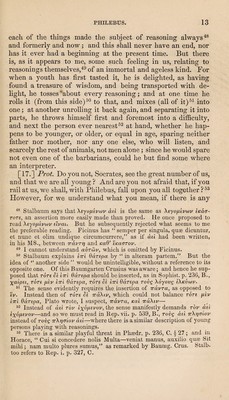
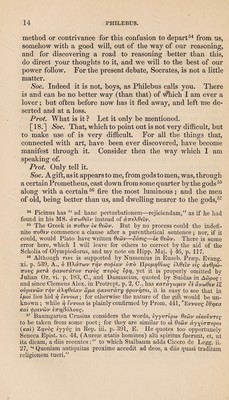
![discourse divided the members and parts of each thing, he shall confute the party, who has confessedthat all these are that^® one, and ridicule him, because he has been compelled to make such monstrous assertions, as that a single one is many and infinite, and many only one. [14.] Prot. Of what other things are you speaking, Socra¬ tes, which have not, as being universally agreed upon, become vulgarized, relating to the very same same subject ? Soc. When, young man, a person lays down that the one does not belong to things generated and destroyed,as we have lately said.^® For in that case, as we just now stated, it has been agreed that we need not confute a oneness of such a kind. But when a person attempts to lay down a oneness, as in the case of one man, and one ox, one beauty, one goodness, respecting these and such-like onenesses, ^^much of attention, together with a division, becomes a controversy.^® Prot. How? [15.] Soc. In the first place, whether a person ought to consider such onenesses as truly existing. In the next place, how it is that these, every one of them being always the same, and never receiving generation or destruction, are, notwith¬ standing, with the greatest stability'^® this one. And after this. In lieu of ^lojuoXoy/jcrajufx/of, read in all the MSS,, and acknow¬ ledged by “ qnis—fatetur ” in Ficinus, Schleiermacher adopted what the sense evidently requires, SioixoXoyrjGaixsvov, furnished by the two Basil edd. Baumgarten Crusius says, however, that SioixoXoyelaOai means, not “ to agree,” but to “ cause to agree: ” whom Stalbaum follows in ed. 2, and thus deserts the other scholar, whom he had followed in the 1st. I cannot understand Ikuvo after to tv. One MS. has sKtivip. Per¬ haps Plato wrote ro ’EXeariKov tv, in allusion to Zeno; as in Pheedr. § 97, Tov ’EXeariKov—Xtyovra—ra avra, ofjcoia Kai dvo/xoia, Kai'iv Kai TroXXd. By things generated and destroyed, says Stalbaum, are meant those that are cognizable by the senses; for those, that are cognizable by intel¬ lect alone, exist the same for ever, as stated in the Timseus, p. 28, A. This is supposed to refer to a previous conversation. 39—39 SucJi ig the literal version of the Greek 77 TroXXrj fitra ^iaiptaeojg dfji(picr(3't]Tr](rig yiyvtrai, out of which the reader is left to make what sense he can. Schiitz, in Opuscul. Philolog. p. 134, wished to in¬ sert Kai between aiTov^ri and fitra—But neither he nor Stalbaum, who is content with the common text, saw that correct Greek would require TToXX?) rj GTZov^Yj. Plato wrote, I suspect, tv TroXXy a-Kovdy [xtydXr} diatpt<Tt(jjg dix^L<T(3rjTr)(TLg yiyvtrai, i. e. ‘ in the midst of much attention a great controversy arises respecting a division.” For MEFAAH AI could easily have been corrupted into MEPA AI. Grou, in the notes to his French version, p. 239, was the first to sug-](https://iiif.wellcomecollection.org/image/b29340986_0004_0019.jp2/full/800%2C/0/default.jpg)




 No text description is available for this image
 No text description is available for this image
 No text description is available for this image