Volume 4
The works of Plato. A new and literal version, chiefly from the text of Stallbaum ... By Henry Cary [vol. II, Henry Davis, vols. III-VI, George Burges] / [Plato].
- Plato
- Date:
- 1848-1854
Licence: Public Domain Mark
Credit: The works of Plato. A new and literal version, chiefly from the text of Stallbaum ... By Henry Cary [vol. II, Henry Davis, vols. III-VI, George Burges] / [Plato]. Source: Wellcome Collection.
40/570 page 32
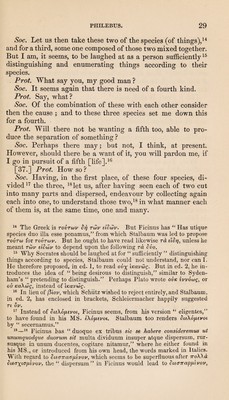
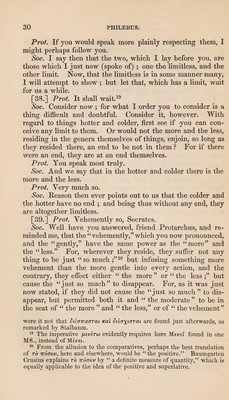
![Soc. A deity (might); if any of the gods will hearken to my prayers. Prot. Pray, then, and take a survey.^^ Soc. I do survey: and some deity, Protarchus, seems now to have become favourable to us. Prot. How say you this ? and of what proof do you make use ? Soc. I will tell you plainly:^'* but do you follow my rea¬ soning. Prot. Only speak. Soc. We mentioned just now the hotter and the colder ; did we not ? Prot. Yes. Soc. To these then add the drier and the moister, the more numerous and the fewer, the swifter and the slower, the larger and the smaller, and whatever things beside that we previously ranked under the one head of a nature, that admits of the more and the less. Prot. You mean of the limitless. [42.] Soc. Yes: and do you combine into this that which we spoke of next afterward, the genus of limit. Prot. What genus ? Soc. That, which, when we should just now have brought together (as the genus) of the limit, formed in the same manner, as we brought together the genus of the limitless, we did not bring together. But now perhaps you will do the same.^^ Here seems to be an allusion to the act of an augur; who, after utter¬ ing a prayer, looked towards heaven to see if the god, to whom he had prayed, answered, or not, with a favourable omen. I cannot understand here drjXov on, and I have therefore omitted with Ficinus on. I could have understood SrjXiov ev n, i. e. “ well making something plain.” 25—25 'pjjig ig English for the Latin of Ficinus—“ idem ages who therefore found in his MS. ravrbv bgd(JHQ in lieu of ravrov dpdtrei: which, I confess, I cannot understand; nor could Stalbaum originally; for in ed. 1, he considered as an interpolation all the words, dXX’ laojg kul vvv rav- Tov bpacTH’ Tovnov (jvvayoiikviov KaTa(pavr]Q KaKsivT] yevrjae- TUL. But in ed. 2, he says that ravrov bpdasi has for its subject some¬ thing not found indeed in the Greek, but which in Latin is “ ipsum genus finiti, cujus nondum subtilior definitio est proposita;” while to show that an idea can be applied to the verb bpdv, he refers to the expression, rav- rbv olfiai bpdaai dv Kai rr]v efxrjv ^vfij3ovXr]v. Perhaps Plato wrote a\\’ i(j(i)Q, e’i y’ kvijv fiot rovro vvv bpdv, aol, rovrivv dfi(porepo)v avvayo- fxsviov, Kara^aviqg KaKeivr] ysvrjaerai, i. e.“ but perhaps, if it is permitted](https://iiif.wellcomecollection.org/image/b29340986_0004_0040.jp2/full/800%2C/0/default.jpg)


 No text description is available for this image
 No text description is available for this image
 No text description is available for this image