Volume 4
The works of Plato. A new and literal version, chiefly from the text of Stallbaum ... By Henry Cary [vol. II, Henry Davis, vols. III-VI, George Burges] / [Plato].
- Plato
- Date:
- 1848-1854
Licence: Public Domain Mark
Credit: The works of Plato. A new and literal version, chiefly from the text of Stallbaum ... By Henry Cary [vol. II, Henry Davis, vols. III-VI, George Burges] / [Plato]. Source: Wellcome Collection.
42/570 page 34
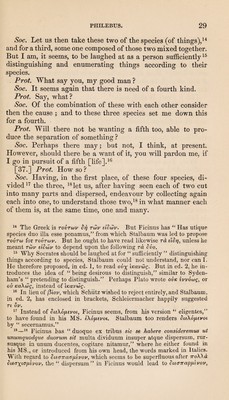
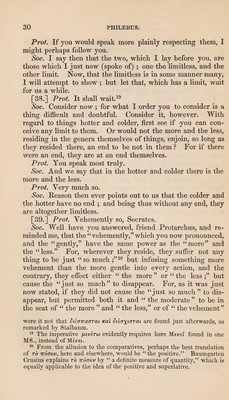
![Prot. Yes, most beautifully. Soc. Moreover it being introduced into cold weather and hot, it takes off the very much, the too much, and the in- finite,^^ but it effects the moderate and the symmetrical. Prot. How not ? Soc. And are not produced from them mild seasons, and all whatever is lovely for us, the limitless and those which have a limit being combined together ? Prot. How not ? Soc. A thousand other things I omit to state; as, for instance, together with health, beauty and strength; and in the soul other properties very many and very beautiful.^^ [43.] For the goddess herself,O thou handsome Philebus, looking down upon lust, and all manner of vice in all persons, (and) (see¬ ing) no limit existing in them of pleasures and their full enjoy¬ ment, has laid down a law and order, having a limit. And you said that she would wear down ; but I maintain, on the contrary, that she would preserve. But how, Protarchus, does it (now) appear to you ? 31—31 Greek is to jn'ev ttoXv \iav Kai aimpov. But the three old¬ est MSS. read \etov for \iav. And so perhaps the MS. of Ficiims, whose version is, “ id quod multum et minus et infinitum dicitur.” Plato wrote, I suspeet, TO fxsv ttXsov koi fielov a<pdXtTo, without aireipov, which “ the more” and “the less” have been shown to he. Stalbaum defends ttoXv X'lav: but those words, I think, are never thus united. Schiitz, in Opuscul. Philolog. p. 138, conceived that something w'as wanting here. For the mention of the goddess of Pleasure could scarce¬ ly thus follow the discussion relating to the combination of the limitless and limit. Stalbaum however, in ed. 2, says, as Sydenham had trans¬ lated, that the deity alluded to is Aphrodite, which in § 5 Socrates states Philebus had identified with Pleasure, and that the goddess of Beauty is here introduced, with reference to the beauty both of body and soul, which had been just now mentioned. Instead of 77 Q^oq, I should prefer rj arj 6s6g, as in § 5. To avoid the want of connexion I have introduced “and ; ” and I suspect that /cat has dropt out after ^iXrjfSs, for k and j3 are very similar in MSS,, as shown by myself at Tro. 935. 35—35 Greek is in some MSS. aTroKvav in others, arroK- vaig; but in one, by a correction, dTroKvaiaai, thus confirming the con¬ jecture of Porson, in Miscellan. Critic, p. 265, adopted by Stalbaum, who, in ed. 2, renders the passage, “ And you indeed think that the goddess wears down, but I that she preserves.” But what is the thing worn down or preserved, he does not distinctly state. More correctly has Sydenham translated, “ And this (the law) you said w'as to impair pleasure, but I, that it was to preserve pleasure.” But in that case Plato would have written, as he probably did, dTroKvaicrai e^rjg TavTa (i. e. vopLov Kai Ta^ir) avTtjv—not dTroKvalaai ’t(pr]g avTrjv—](https://iiif.wellcomecollection.org/image/b29340986_0004_0042.jp2/full/800%2C/0/default.jpg)


 No text description is available for this image
 No text description is available for this image
 No text description is available for this image