Volume 4
The works of Plato. A new and literal version, chiefly from the text of Stallbaum ... By Henry Cary [vol. II, Henry Davis, vols. III-VI, George Burges] / [Plato].
- Plato
- Date:
- 1848-1854
Licence: Public Domain Mark
Credit: The works of Plato. A new and literal version, chiefly from the text of Stallbaum ... By Henry Cary [vol. II, Henry Davis, vols. III-VI, George Burges] / [Plato]. Source: Wellcome Collection.
46/570 page 38
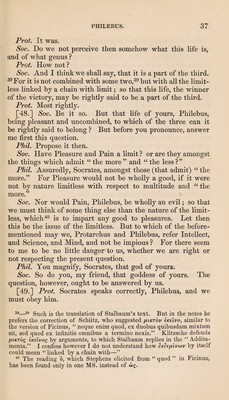
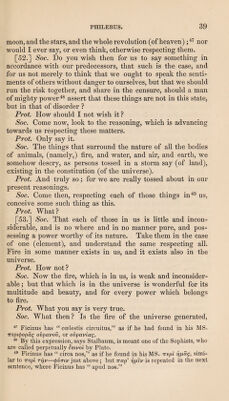
![Phil. Have not you, Protarchus, taken upon yourself to speak on my part ? Prot. Certainly. But in the present case I am nearly at a loss; and I request of you, Socrates, to become yourself a speaker for us, in order that we may not, by a mistake respect¬ ing the combatant,^^ say something contrary to the measure. Soc. We must obey, Protarchus. For you enjoin nothing difficult. But when I was magnifying, as Philebus says, (a deity)by way of a joke, I did in reality confuse you, by asking of what genus were Mind and Science. Prot. Altogether so, Socrates. [50.] Soc. And yet it was an easy (question). For all the wise, in reality extolling themselves, agree that Mind is to us a king of heaven and earth.^® And perhaps they say well. But let us, if you are willing, make our examination of this genus rather more at length. Prot. Speak as you wish, taking no account of the length, as you will not be disagreeable (to us). [51.] Soc. You have spoken fairly. Let us begin, then, by asking a question in such way as this. Prot. How ? Soc. Whether shall we say that the power of an irrational (principle) governs all things, and that, which is called the universe, at random, and as may happen? or, on the con¬ trary, as our predecessors asserted,^® that Mind and a certain wonderful Intellect, arranges things together, and governs throughout ? Prot. Alike in nothing, Socrates, (are the two tenets). For what you have just now mentioned seems to me to be impious. But, to say that Intellect disposes all things in order, is worthy of our view of the world, and of sun, and the Sydenham has, “ I am much at a loss;” what the sense requires. Hence for fikvToi (r%£^6v Plato probably wrote fxeya n (T%£^6r— ^2 By dycjvKrrT^v, says Stalbaum, is meant Intellect, as opposed to Pleasure, Stalbaum quotes opportunely from Horace, “ nil extra numerum fecisse modumque Curas.” This word, absolutely requisite for the sense, is found only in the version of Ficinus—“ deum extollens jocando.” Stalbaum has given, from the notes of Wyttenbach on Phmdo, § 11, and of Creuzer on Plotinus n£pi KdXXoi;?, p. 90, a list of the Neo- Platonists, who have referred to this dictum. Plato alludes to Anaxagoras. See Valckenaer in Diatrib. p. 40, B.](https://iiif.wellcomecollection.org/image/b29340986_0004_0046.jp2/full/800%2C/0/default.jpg)




 No text description is available for this image
 No text description is available for this image
 No text description is available for this image