Volume 4
The works of Plato. A new and literal version, chiefly from the text of Stallbaum ... By Henry Cary [vol. II, Henry Davis, vols. III-VI, George Burges] / [Plato].
- Plato
- Date:
- 1848-1854
Licence: Public Domain Mark
Credit: The works of Plato. A new and literal version, chiefly from the text of Stallbaum ... By Henry Cary [vol. II, Henry Davis, vols. III-VI, George Burges] / [Plato]. Source: Wellcome Collection.
528/570 (page 520)
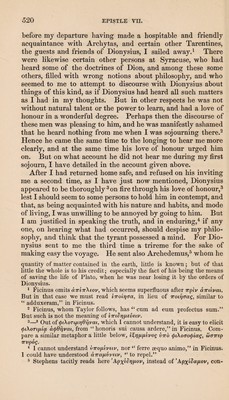
![before my departure having made a hospitable and friendly acquaintance with Archytas, and certain other Tarentines, the guests and friends of Dionysius, I sailed away.^ There were likewise certain other persons at Syracuse, who had heard some of the doctrines of Dion, and among these some others, filled with wrong notions about philosophy, and who seemed to me to attempt to discourse with Dionysius about things of this kind, as if Dionysius had heard all such matters as I had in my thoughts. But in other respects he was not without natural talent or the power to learn, and had a love of honour in a wonderful degree. Perhaps then the discourse of these men was pleasing to him, and he was manifestly ashamed that he heard nothing from me when I was sojourning there.^ Hence he came the same time to the longing to hear me more clearly, and at the same time his love of honour urged him on. But on what account he did not hear me during my first sojourn, I have detailed in the account given above. After I had returned home safe, and refused on his inviting me a second time, as I have just now mentioned, Dionysius appeared to be thoroughly ^ on fire through his love of honour,^ lest I should seem to some persons to hold him in contempt, and that, as being acquainted with his nature and habits, and mode of living, I was unwilling to be annoyed by going to him. But I am justified in speaking the truth, and in enduring,'^ if any one, on hearing what had occurred, should despise my philo¬ sophy, and think that the tyrant possessed a mind. For Dio¬ nysius sent to me the third time a trireme for the sake of making easy the voyage. He sent also Archedemus,^ whom he quantity of matter contained in the earth, little is known; hut of that little the whole is to his credit; especially the fact of his being the means of saving the life of Plato, when he was near losing it by the orders of Dionysius. ^ Ficinus omits aTreTrXeov, which seems superfluous after Trptv airiivai. But in that case we must read krcoiriaa, in lieu of Troirjcrag, similar to “ adduxeram,” in Ficinus. 2 Ficinus, whom Taylor follows, has cum ad eum profectus sum.” But such is not the meaning of lTTidr]ntvHv. 2® Out of (piXoTijirjOrivai, which I cannot understand, it is easy to elicit (piXoTifji'iq, a<p9rivai, from “ honoris sui causa ardere,” in Ficinus. Com¬ pare a similar metaphor a little below, k^rjfifxevog vtto <piKo<7o^iag, ojairep 'jrvpog. * I cannot understand vTrofieveiv, nor “ ferre aequo animo,” in Ficinus. I could have understood aTrafivveiv, “ to repel.” ^ Stephens tacitly reads here ’ApxsSrjfiov, instead of ’Ap^i'^a/zov, con-](https://iiif.wellcomecollection.org/image/b29340986_0004_0528.jp2/full/800%2C/0/default.jpg)