The effects of mepacrine on the gastrointestinal tract of man / by the Army Malaria Research Unit and the Nuffield Institute for Medical Research, Oxford.
- Great Britain. Army Malaria Research Unit.
- Date:
- 1946
Licence: Public Domain Mark
Credit: The effects of mepacrine on the gastrointestinal tract of man / by the Army Malaria Research Unit and the Nuffield Institute for Medical Research, Oxford. Source: Wellcome Collection.
3/12
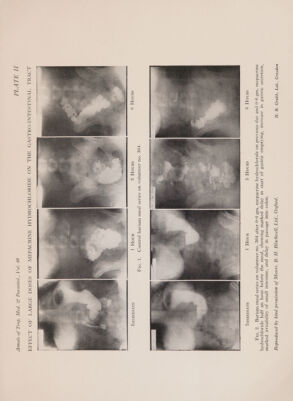
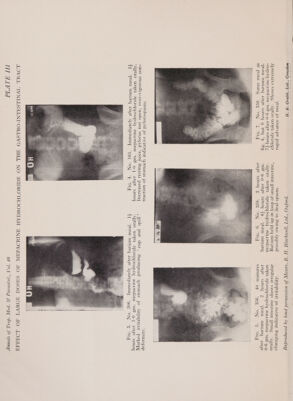
![| Reprinted from the ‘ Annals of Tropical Medicine & Parasitology, Vol. 40. No.1. April, 1946.] Peer PECTS OF MEPACRINE ON THE GASTRO- INTESEINAL TRACT OF MAN BY THE ARMY MALARIA RESEARCH UNIT* AND Tite NUGPIPED INSTITUTE FOR MEDICAL RESEARCH, OXFORD (Received for publication January 14th, 1946) The most frequent toxic effect of mepacrine administration is a disturbance of the gastro-intestinal tract, which varies in severity from a slight diarrhoea to intense nausea, vomiting and severe diarrhoea accompanied by fever and prostration. Fortunately these unpleasant side-effects are seldom seen when mepacrine is given in doses of 0-1 gm. a day. Shortly before the Army Malaria Research Unit began its work, however, diarrhoea and vomiting suddenly occurred on a large scale in North Africa among troops who had recently begun to take suppressive doses of mepacrine, and it was decided to make a study of the effects of the drug on the gastro-intestinal tract. Preliminary experiments were done in animals to determine the relative toxicities of different salts of mepacrine, to estimate the effects of different modes of administration, and to work out the mechanism of the disturbance. ‘These experiments have in part been reported (Army Malaria Research Unit, 1945). Human experiments were then undertaken. Observations were made on a large number of volunteers taking various amounts of mepacrine, and a limited number of cases were submitted to intensive investigation by means of fractional test meals, barium meals, cholecystography, gastroscopy and bacterial examination of the stools. The results of the human experiments are presented in this paper. They show that when mepacrine is given in what is now the common suppressive dose, 0-1 gm. a day, gastro- intestinal disturbances are slight and infrequent, and they suggest an explanation of the serious effects seen after the intermittent dosage used in North Africa in 1943. TECHNIQUES Barium Meals. All the women volunteers had two control barium meals before the exhibition of mepacrine. ‘The soldier volunteers had one control meal. There was no preliminary preparation, and the volunteers were on their normal diet the day before the experiment. On the morning of the barium meal they had a cup of tea on awakening. After the three-hour film they were given two cups of tea and some sandwiches, and they resumed their normal diet after the six-hour films. ‘The opaque meal consisted of 1/8 pint of Horlick’s Shadow Food mixed with an equal amount of water. All the films were taken with a Lysholm Grid but without the use of a Potter-Bucky diaphragm. Films were taken, after preliminary screening, immediately after the barium meal was given, * Lt.-Col. B. G. Maegraith, R.A.M.C., Major Malcolm Brown, R.C.A.M.C., Major R. J. Rossiter, ery ot eviajor i. IN. Irvine, R.A. MiLC., Capt. J. C. Lees, R.A.M.C., Capt. D.S. Parsons, R.A.M.C., ‘Capt. ©. N: Partington, R.A.MEC., Capt. J. L. Rennie, R.A.M.C., and Surgeon Lt. R. E. Havard, REN. ¥-R: Major H. W. Davies, R.A.M.C., Capt. E. H. Hanson, R.A.M.C., and Miss I. M. Pearson, with + Dr. K. J. Franklin, Dr. A. E. Barclay and Miss M. M. L. Prichard. Se)](https://iiif.wellcomecollection.org/image/b32177719_0003.jp2/full/800%2C/0/default.jpg)