Guide to the galleries of mammalia (mammalian, osteological, cetacean) in the Department of Zoology of the British Museum (Natural History).
- British Museum (Natural History). Department of Zoology.
- Date:
- 1887
Licence: Public Domain Mark
Credit: Guide to the galleries of mammalia (mammalian, osteological, cetacean) in the Department of Zoology of the British Museum (Natural History). Source: Wellcome Collection.
19/138 page 11
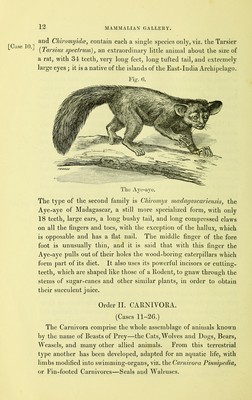
![LEMURS. n consists of a number of very remarkable animals^ of a far lower type than those we have hitherto mentioned; they are for the most part natives of Madagascar, although a few aberrant members of the group are found in Africa and Southern Asia. They are invariably arboreal in their habits, with generally long, bushy, and non-pre- hensile tails, opposable thumbs and great toes, large eyes, and long dog-like faces. They are divided into three families, of which the typical one, the LemuridcR, contains all but the whole of the species. It is subdivided into the following groups :— 1. The IndrishuE {Indris and Propithecus), from Madagascar, characterized by their disproportionately long hind limbs, hind toes united by skin, and the possession of only 30 teeth. They are exhibited in separate Cases in the centre of the Gallery, and in the recess between Pier-cases 5 and 8. They are singularly variable in their colour, as maybe seen by the mounted groups of the different species. When on the ground they move in an upright position, hold- ing their arms over their heads in order to balance themselves, and progressing by short leaps, in a most awkward and ludicrous manner. 2. The LemurincB or true Lemurs (Case 10), also confined to [Case 10.] Madagascar, have fore and hind limbs of nearly equal length, toes free to the base, and 36 teeth. They are more quadrupedal in their actions than the last group, moving about both on the ground and in trees with great activity. Like the Propitheci, they are very variable in their coloration, being marked with various shades of red, brown, and black. Specimens of the Euflfed Lemur (Varecia varia) are exhibited in the same Recess as the Propitheci. 3. The Galoginince are distinguished by the unusual elongation of their tarsal bones. There are two genera, of which the first, Chirogale, contains 3 or 4 small species, with long bushy tails and soft woolly fur. They are very like large dormice, both in their appearance and habits, building nests and hibernating during the winter. Galago, the second genus, is found in Africa, and dis- tributed from Senegambia to Mozambique. 4. The group of Lorisince contains 5 or 6 rare and curious forms, such as the Potto [Perodicticus potto) of Western Africa, and the Loris of India and Ceylon. Specimens of both are exhibited in Case 10. The second and third families of the Lemuroidea, the Tarsiidee](https://iiif.wellcomecollection.org/image/b28092624_0019.jp2/full/800%2C/0/default.jpg)

 No text description is available for this image
 No text description is available for this image
 No text description is available for this image