Guide to the galleries of mammalia (mammalian, osteological, cetacean) in the Department of Zoology of the British Museum (Natural History).
- British Museum (Natural History). Department of Zoology.
- Date:
- 1887
Licence: Public Domain Mark
Credit: Guide to the galleries of mammalia (mammalian, osteological, cetacean) in the Department of Zoology of the British Museum (Natural History). Source: Wellcome Collection.
33/138 page 25
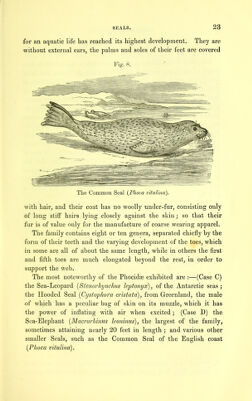
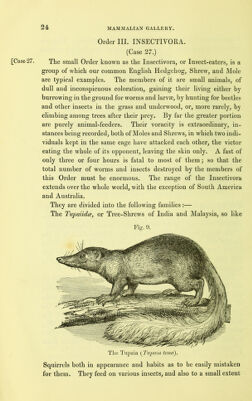
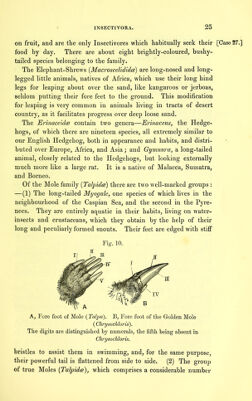
![on fruit, and are the only Insectivores which habitually seek their [Case 27.] food by day. There are about eight brightly-coloured, bushy- tailed species belonging to the family. The Elephant-Shrews {Macroscelididce) are long-nosed and long- legged little animals, natives of Africa, which use their long hind legs for leaping about over the sand, like kangaroos or jerboas, seldom putting their fore feet to the ground. This modification for leaping is very common in animals living in tracts of desert country, as it facilitates progress over deep loose sand. The Erinaceidce contain two genera—Erinaceus, the Hedge- hogs, of which there are nineteen species, all extremely similar to our English Hedgehog, both in appearance and habits, and distri- buted over Europe, Africa, and Asia; and Gymnura, a long-tailed animal, closely related to the Hedgehogs, but looking externally much more like a large rat. It is a native of Malacca, Sumatra, and Borneo. Of the Mole family {Talpidce) there are two well-marked groups : —(1) The long-tailed Myogale, one species of which lives in the neighbourhood of the Caspian Sea, and the second in the Pyre- nees. They are entirely aquatic in their habits, living on water- insects and crustaceans, which they obtain by the help of their long and peculiarly formed snouts. Their feet are edged with stiff Fig. 10. A, Fore foot of Mole {Talpd). B, Fore foot of the Golden Mole ( Chrysochloris). The digits are distinguished by numerals, the fifth being absent in CJirysochlm'is. bristles to assist them in swimming, and, for the same purpose, their powerful tail is flattened from side to side. (2) The group of true Moles (Talpida), which comprises a considerable number](https://iiif.wellcomecollection.org/image/b28092624_0033.jp2/full/800%2C/0/default.jpg)
 No text description is available for this image
 No text description is available for this image
 No text description is available for this image