Guide to the galleries of mammalia (mammalian, osteological, cetacean) in the Department of Zoology of the British Museum (Natural History).
- British Museum (Natural History). Department of Zoology.
- Date:
- 1887
Licence: Public Domain Mark
Credit: Guide to the galleries of mammalia (mammalian, osteological, cetacean) in the Department of Zoology of the British Museum (Natural History). Source: Wellcome Collection.
35/138 page 27
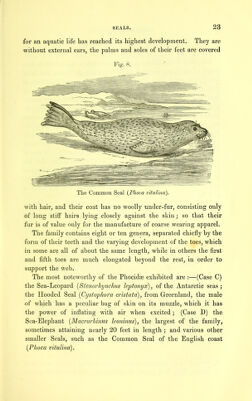
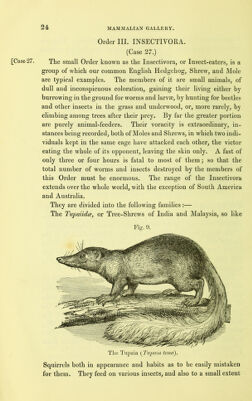
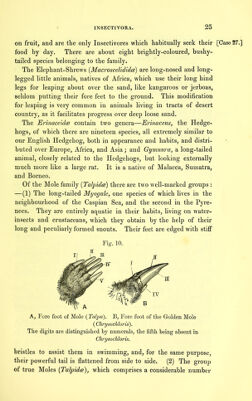
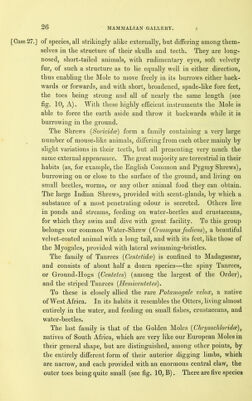
![BATS. of Chrysochloris, some of them remarkable for the iridescence of their fur, which can be preserved by placing the animal in spirit, but entirely fades when it is dried and stuffed. ' Order IV. CHIEOPTERA. (Case 27.) The Chiroptera*, or Bats, form one of the most sharply defined [Case 27.] of all the Orders of Mammalia, being characterized by the modifica- tion of the fore limbs into true wings, having the power of flap- ping and propelling the animal through the air. The structure of a Bat’s wing is of a very simple character. It consists of a frame- work, formed by the bones of the arm and the enormously elon- gated fingers, between which the flying membrane (a continuation of the skin of the body) is expanded, being attached behind to the front of the hind leg. In many species there is also an addi- tional membrane spread between the hind legs, in which the tail is included. The thumb alone is free and assists in locomotion during the awkward attempts of the animal to walk on all fours. The hind limbs, which in other mammals have the function of propelling the body forwards, are almost entirely relieved of that office, being singularly weak and feeble, and of but little use to the animal except while asleep or resting, when it hooks the sharp claws, with which the hind toes are furnished, on to some support, and remains suspended with the head downwards until again ready to fly. The Chiroptera are divided into two distinct Suborders—the Frugivorous and Insectivorous Bats, of which the first, as a rule, are of large size, with flattened teeth, suited for munching fruit, and with claws both on their first and second fingers; the latter are of smaller size, with sharp-pointed teeth, suitable for crushing insects, and with claws on their thumbs only. Of the fruit-eating Bats, the most worthy of mention are the large brightly-coloured Flying Foxes, of which certain species, for example the Philippine Fruit-Bat [Pteropus juhatus), reach to * Greek, cheir, a hand, and ‘pteroriy a wing.](https://iiif.wellcomecollection.org/image/b28092624_0035.jp2/full/800%2C/0/default.jpg)
 No text description is available for this image
 No text description is available for this image
 No text description is available for this image