Hand atlas of human anatomy / by Werner Spalteholz ; translated from the 3rd German edition by Lewellys F. Barker.
- Spalteholz, Werner, 1861-1940. Handatlas der Anatomie des Menschen. English
- Date:
- 1900-
Licence: In copyright
Credit: Hand atlas of human anatomy / by Werner Spalteholz ; translated from the 3rd German edition by Lewellys F. Barker. Source: Wellcome Collection.
26/896 (page 14)
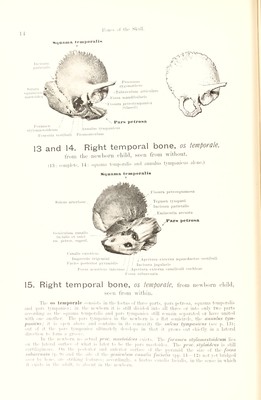
![HolKS of tin* Skull. Kiinaiiut temporalis I ncisura parieiali* Processus zygomaticus -Tuberculum articulare Fossa mandibular is Fissura petrotympaniea [Glaseri | \ Pars petrosa Foramc*n / st vlmnastoidcuin Annulus tynipanicus Fenestra vestibuli Proniontorium 13 and 14. Right temporal bone, os temporale, from 1 lie newborn child, seen from without. 113: complete, 14: squama temporalis and annulus tympanieus alone.) Squama temporalis Y Fissura petrosquamosa Tegmen tympani Incisura parietalis Emincntia arenata Canalis can»ticu- Impressio trigemini l ‘ ' j Apertura externa aquaeductus vestibuli Kiu-i.- posterior pyramids ; j i Im.isura jugu]aris Purus acusticus internus J Apertura externa canaliculi cochleae Fossa subarcuata Sulcus arteriosu (ieniculum canalis facialis et sulci nil. petros. super!'. l*ar« petrosa 15. Right temporal bone, os temporale, from newborn child, seen from within. The <*s temporale consists in the foetus of three parts, pars petrosa, squama temporalis and pars tympaniea: in the newborn it is still divided into all three or into only two parts according as the squama temporalis and pars tympaniea still remain set titrated or have united with one another. The pars tympaniea in the newborn is a fiat semicircle, the annulus ll/m- panicus; it is open abo\e and contains in it> eoneavitv the sulcus tympanieus (see p. 13); out of it the pars tympaniea ultimatelj develops in that it grows out eltiefly in a lateral direction to form a groove. In the newborn ik actual jiroc. masloidcas exists. The foramen stylomustoiileum lies on the lateral surlaee ot what is later to lie the pars mastoidea. The proc. styloideus is still eartilagit.. (in the posterior and anterior surface of the pyramid the size of the fossa subarcuata (p. d) and the >ite of the yenicuhnn canalis facialis (pp. 11 —12) not vet bridged over lyv hone, tire striking features; accordingly, a hiatus canalis facialis, in the sense in which it exists in the adult, is absent in the newborn.](https://iiif.wellcomecollection.org/image/b29336211_0026.jp2/full/800%2C/0/default.jpg)