On military and camp hospitals, and the health of troops in the field : being the results of a commission to inspect the sanitary arrangements of the French Army, and incidentally of other armies in the Crimean War / by L. Baudens ; translated and annotated by Franklin B. Hough.
- Date:
- 1862
Licence: Public Domain Mark
Credit: On military and camp hospitals, and the health of troops in the field : being the results of a commission to inspect the sanitary arrangements of the French Army, and incidentally of other armies in the Crimean War / by L. Baudens ; translated and annotated by Franklin B. Hough. Source: Wellcome Collection.
Provider: This material has been provided by the Royal College of Physicians of Edinburgh. The original may be consulted at the Royal College of Physicians of Edinburgh.
71/280 page 57
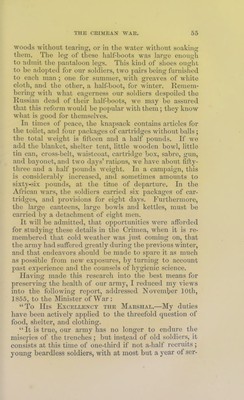
![the Avood which came to Karaiesch from Varna. This forest, in a hygienic point of view, fulfilled expectations. The six weeks -which three divisions of the tirst corps spent there, could not have been more I'avorable to the health of the troops, and especially that of the recruits. The camps placed upon the undulatino; plateaux of the Crimea, were also in perfect health. Unfortunately not a single tree was left; and the subterranean forest, that is, the roots of trees cut down the year before, are nearly exhausted. It is useless to think of building huts, tents must be resorted to. Where the soil was calcareous, they dug a circular pit, some two feet deep, in which the tent was ])laced, making a gutter around it, for drawing off the rain water. The materials taken out served to build a wall around it, about two feet high, so that the soldier, when in bed, was sheltered entirely from the wind and the rain. The shelter would have been complete had they added a fireplace, as in the ofiicers' tents. Where the soil was not calcareous, the arrangement was sooner made, but not as good, for the circular bank, in form of a parapet made around the tent, was not to be compai-ed with the wall of dry stones, and the ditches had to be paved, to hinder the water from filtering into the inside of the tent. It is necessary to furnish the men with either a sheepskin or a plank (biscuit boxes answer the purpose), to keep them from the ground, and a jjiece of oiled cloth which they could form into a mantle, by wrapping it around tliem on rainy days. The shelter-tent is entirely insufficient for winter, and it is so short that it does not cover the feet of the men. It may be advantageously replaced by the conical tent, fashioned after those of the Turks, of all tents the warm- est and strongest to resist a gale of wind. Tents should always be set as far apart as possible, and when the weather permits, should be moved at least every four days. When the sun shines the contents should be exposed to the air, and the tents should themselves bo taken down; but unfortunately this very essential requirement is not attended to, even in the field hospi- 4](https://iiif.wellcomecollection.org/image/b21951780_0071.jp2/full/800%2C/0/default.jpg)