Report of the Pellagra Commission of the State of Illinois, November, 1911.
- Illinois. Pellagra Commission.
- Date:
- 1912
Licence: In copyright
Credit: Report of the Pellagra Commission of the State of Illinois, November, 1911. Source: Wellcome Collection.
Provider: This material has been provided by Royal College of Physicians, London. The original may be consulted at Royal College of Physicians, London.
19/279 page 13
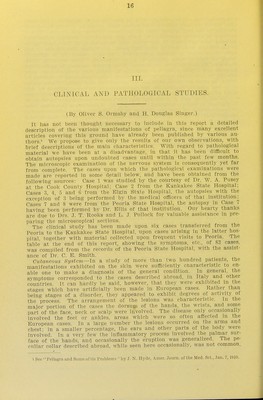
![Tadle VI. Year. Pellagra given as imme- diate cau.se. Other causes. Total deatlis. Per- centage of cases. Number. Per cent. Number. Per cent. 1909 89 S 4 81.0 03.7 100.0 21 (j 19.0 36.3 110 14 4 62.1.5 16.42 28.57 1910 1911 Total 101 78.9 27 21.1 128 49.61 Other Causes of Death. Pulmonary Tuberculosis Valvular Heart Disease Pneumonia Epilepsy Cerebral Haemorrhage : Cerebral Embolism Cholecystitis Amoebic Dysentery Chronic Nephritis Senile Gangrene General Paralysis of the Insane Carcinoma Uteri /' Accidental 27 In discussing these tables attention may first be directed to the class of individuals most affected. In general it may be said that the disease is especially frequent for some reason, at present unknown, among the chronic insane. Most of the patients who have suffered from pellagra have belonged to the groups of defectives, senile dements, epileptics, and the terminal stages of dementia praecox. They have been for the most part poorly nour- ished and in an enfeebled state of bodily health. The total population of the Peoria State Hospital during the great epidemic of 1909 was about 2 100 and of this number of patients we find at least 8.4 per cent showed 'definite symptoms of pellagra. Yet during this period none of the employes suffered . rom the disease m spite of the fact that they were exposed fully as much to the bites ot insects and drew their food and water supply from exactly the same source as the patients. This freedom from pellagra upon the part of doctors nurses, attendants and other employes has been absolute in all the institutions. It is furthermore almost certain that some of those employes fn wh?nrnin ^ ^tate of health at some time during the seasons in which pellagra was rampant. While the general statement made above is true that the individuals have been weakly and ill-nourished there are however notable exceptions Some of the pel]a_gnns have been apparently robust and well nourished In this connecMon it may be of interest to refer to a patient seen by Dr. Oliver S Ormsby in 1911 who does not figure in the tables given here as the disease was contracted in Kentucky and the patient came to Chicago only for med ical advice. This lady was 44 years of age. native of Maine, but had iTve 1 >n Kentucky for ]2 years where she was at the head of a college depa tmen of domestic science. Her duties therefore consisted of the teach ni of hygiene as regards management and dietary of the household She had](https://iiif.wellcomecollection.org/image/b2398322x_0019.jp2/full/800%2C/0/default.jpg)