The Snell exhibitions : From the University of Glasgow to Balliol college, Oxford / By W. Innes Addison.
- William Innes Addison
- Date:
- 1901
Licence: Public Domain Mark
Credit: The Snell exhibitions : From the University of Glasgow to Balliol college, Oxford / By W. Innes Addison. Source: Wellcome Collection.
5/250
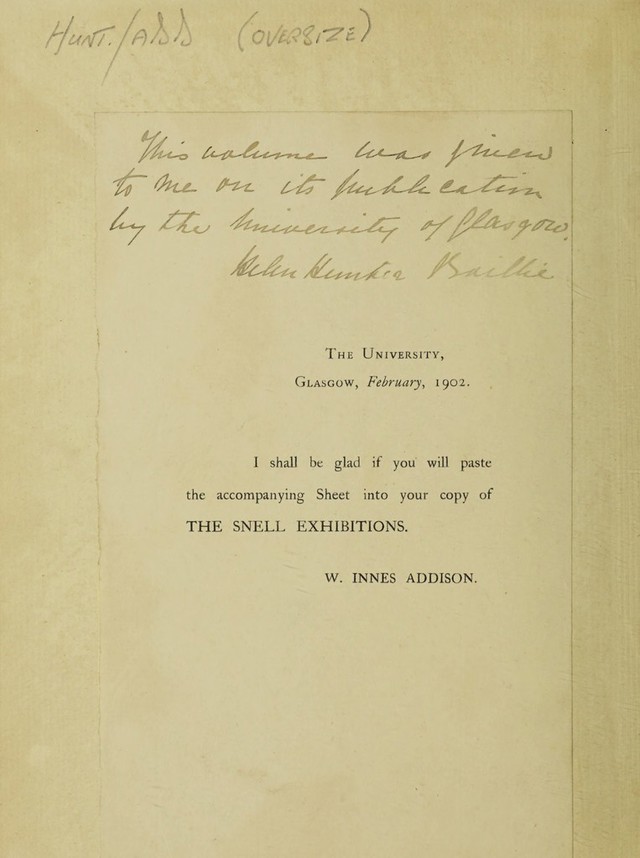
![THE SNELL EXHIBITIONS from the University of Glasgow to Balliol College, Oxford, by W. Innes Addison. [Glasgow: James MacLehose & Sons, 1901.] Since this volume was published, Mr. A. L. Cooper of Reading and Mr. G. W. Campbell of Leamington have kindly communicated to the author the following extracts, which supplement in a very important manner the biographical particulars concerning “The Founder.” The first is taken from a Survey of the Antiquities of the City of Oxford composed in 1661-6 by Anthony Wood; edited by Andrew C/arh, ALA., Rector of Great Leighs, Essex. Vol. III., Addenda and Indexes. Oxford, 1899: page 187. “Monumental Inscriptions “—Holywell or St. Cross—In the Chancel—On a black marble, lying at the upper “ end, neare the north wall:—‘Depositum Johannis Snell, Scoto-Britanni, armigeri, qui “‘obiit vi die Augusti anno aetatis 50 salutis 1679.’ Armes are ‘quarterly or and ‘“gules, a cross patonce counter-changed.’ This John Snell, the son of Andrew “Snell and Margaret his wife (daughter of John Carnahan) was borne in the parish “ of Comonnell in Carrick in the sherivedome of Aire in Scotland; bred in the “Universitie of Glasgow under the care of Mr. James Darumpley, professor of “philosophic; came into England in the time of Oliver Cromwell in a verie meane “ condition, and, in his journey through Lancashire, calling at the house of the lady “ Houghton at Walton neare Houghton tower (one of the daughters of Sir Roger “Aston a Scotchman,1 who was first King James his barber and afterwards master of “the robes) told the person that came to the dore to give him an answer, that ‘ he “ ‘ was a poore Scotchman and a scholar, and hearing that a gude lady, his country- “ ‘woman, lived there, he took the boldness to make himself knowne to her, and to “ ‘ crave some employment in her service,’ &c. Whereupon after the lady had “ discoursed with him, shee appointed him to keep the accompts, wait upon her, and “ to say prayers in the family. After he had continued there about an yeare he upon 1 He was a natural son of John Aston, second son of Richard Aston, of Aston, Cheshire ; but, as he had been bred in Scotland, he was generally taken for a Scot. He is described as a plain, honest man, often employed by King James to carry messages to Elizabeth. He died in 1612, leaving a great fortune to his daughters, the eldest of whom, Margaret (by his first wife Mary Stuart, daughter of Lord Ochiltree), was married to Sir Gilbert Hoghton, 2nd Bart. [See Wood’s Fasti, I., 315, and Le Neve’s Monurnenta Anglicana, I., 33.]](https://iiif.wellcomecollection.org/image/b31353460_0005.jp2/full/800%2C/0/default.jpg)