A note on the inhibitory effect of monoiodoacetic acid on lactic acid production by cancer tissue / by Sylvia Thurlow Harrison and Edward Mellanby.
- Harrison, Sylvia Thurlow.
- Date:
- [1931?]
Licence: In copyright
Credit: A note on the inhibitory effect of monoiodoacetic acid on lactic acid production by cancer tissue / by Sylvia Thurlow Harrison and Edward Mellanby. Source: Wellcome Collection.
2/4
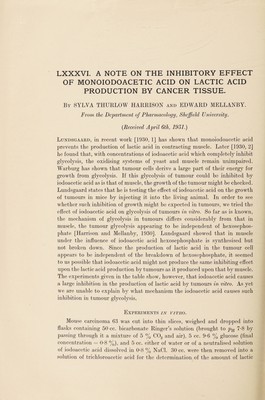
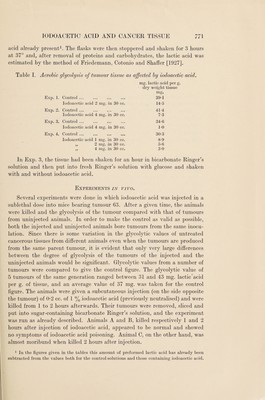
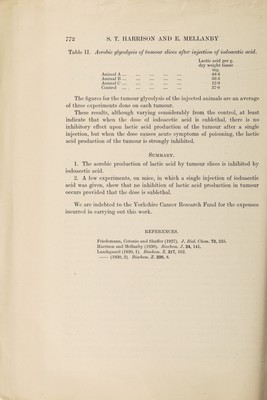
![LXXXVI. A NOTE ON THE INHIBITORY EFFECT OF MONOIODOACETIC ACID ON LACTIC ACID PRODUCTION BY CANCER TISSUE. By SYLYA THURLOW HARRISON and EDWARD MELLANBY. From the Department of Pharmacology, Sheffield University. (Received April 6th, 1931.) Lundsgaard, in recent work [1930, 1] has shown that monoiodoacetic acid prevents the production of lactic acid in contracting muscle. Later [1930, 2] he found that, with concentrations of iodoacetic acid which completely inhibit glycolysis, the oxidising systems of yeast and muscle remain unimpaired. Warburg has shown that tumour cells derive a large part of their energy for growth from glycolysis. If this glycolysis of tumour could be inhibited by iodoacetic acid as is that of muscle, the growth of the tumour might be checked. Lundsgaard states that he is testing the effect of iodoacetic acid on the growth of tumours in mice by injecting it into the living animal. In order to see whether such inhibition of growth might be expected in tumours, we tried the effect of iodoacetic acid on glycolysis of tumours in vitro. So far as is known, the mechanism of glycolysis in tumours differs considerably from that in muscle, the tumour glycolysis appearing to be independent of hexosephos- phate [Harrison and Mellanby, 1930]. Lundsgaard showed that in muscle under the influence of iodoacetic acid hexosephosphate is synthesised but not broken down. Since the production of lactic acid in the tumour cell appears to be independent of the breakdown of hexosephosphate, it seemed to us possible that iodoacetic acid might not produce the same inhibiting effect upon the lactic acid production by tumours as it produced upon that by muscle. The experiments given in the table show, however, that iodoacetic acid causes a large inhibition in the production of lactic acid by tumours in vitro. As yet we are unable to explain by what mechanism the iodoacetic acid causes such inhibition in tumour glycolysis. Experiments in vitro. Mouse carcinoma 63 was cut into thin slices, weighed and dropped into flasks containing 50 cc. bicarbonate Ringer’s solution (brought to y>H 7-8 by passing through it a mixture of 5 % C02 and air), 5 cc. 9-6 % glucose (final concentration = 0-8 %), and 5 cc. either of water or of a neutralised solution of iodoacetic acid dissolved in 0*8 % NaCl. 30 cc. were then removed into a solution of trichloroacetic acid for the determination of the amount of lactic](https://iiif.wellcomecollection.org/image/b30628969_0002.jp2/full/800%2C/0/default.jpg)