Report of the Commissioners appointed in pursuance of an act of parliament made and passed in the 5th and 6th years of King William the 4th, c. 71 : instituted, "An act for appointing commissioners to continue the inquiries concerning charities in England and Wales, until the first day of March one thousand eight hundred and thirty-seven." (Dated 30th June 1837.) Presented to both Houses of Parliament by command of Her Majesty.
- Great Britain. Commissioners for Inquiring Concerning Charities
- Date:
- 1840
Licence: Public Domain Mark
Credit: Report of the Commissioners appointed in pursuance of an act of parliament made and passed in the 5th and 6th years of King William the 4th, c. 71 : instituted, "An act for appointing commissioners to continue the inquiries concerning charities in England and Wales, until the first day of March one thousand eight hundred and thirty-seven." (Dated 30th June 1837.) Presented to both Houses of Parliament by command of Her Majesty. Source: Wellcome Collection.
Provider: This material has been provided by King’s College London. The original may be consulted at King’s College London.
55/398 (page 51)
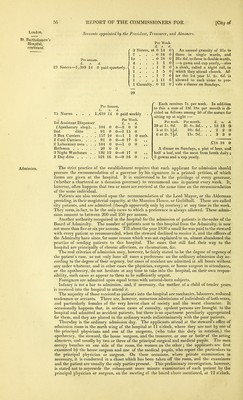
![St. London. Bartholomew's Hospital, continued. The Renter. Matron. Surveyor. Carpenter. Renter.—This officer, who also has a house within the building, keeps the rental of the hospital, collects the yearly rents both in town and country, the tithes and other annual pay- ments, and pays the amount to the banker of the treasurer, from whom he receives from time to time cash for small payments on account of the hospital. He is not allowed to retain above 200/. in his hands. He enters every item of the receipt and expenditure of the hospital first in the day-book, and then in the pay-ledger or ieceipt-ledger. He makes up the cash-books of receipts and payments as between himself and the treasurer monthly, for the examination of the almoners ; also the annual account of the hospital affairs rendered in May yearly, which contains an account of rents due to the Michaelmas preceding, and of receipts and payments to the 31 st December preceding. For these duties he receives a salary of 210/., and a commission of per cent, (or ?jd. in the pound) on the amount of the rents collected; this usually amounts to about 300/. per annum, and is paid by a cheque from the treasurer at the close of the year. The present renter (Mr. William Walker Wilby) had been steward of the hospital for 13 years previous to his appointment as renter in 1828, and in consideration of his services in that capacity, a gratuity of 150/. per annum was granted him in addition to his other emolu- ments. This payment has since been continued, thus raising the total amount of his I'emu- neration to about 600/. per aimum. Matron.—The matron attends to the accommodation of the patients in the wards. She exercises a general superintendence over the sisters and nurses, and sees that they perform their duties in cleansing the wards, and in constant attendance during the night. She keeps the linen bedding, &c., of the hospital; and in case any of the female patients are incapable of taking care of their clothes and money, she takes charge and keeps an account of them. A residence is provided for her within the hospital, in which she is expected to be constantly m attendance except on leave from the treasurer or two almoners; she is forbidden to receive any fees or other gratuity from the patients. Surveyor.—The surveyor (Philip Hardwicke, Esq.) is elected annually by the general court; he attends the treasurer, almoners, and committees, and the views when required. His duty is to inspect the buildings of the hospital and upon the estates, to measure and esti- mate the necessary repairs, to arrange the terms of lettings, to make out plans for leases to the tenants, schedules of fixtures, to fix the amount in which buildings should be insured, and to watch encroachments on the property. He superintends the department of the carpenter in the execution of repairs. His salary is 210/. per annum. No residence is provided for him. Carpenter.—The duty of the clerk of the works, or carpenter, is to superintend the repairs of the hospital, for which purpose he has an establishment of five or six men under him. He keeps the time bills of the workmen employed, and the accounts of all materials used. His salary is 3/. 3j. per week; he has also a house in the hospital. Medical and Surgical Establishment. The medical and surgical establishment is appointed by the General Court. It comprised. Medical and Surgi- at the commencement of this Inquiry (September, 1836) three principal physicians, and three cal Establishment, assistant physicians, three principal surgeons, and three assistant surgeons, of whom none reside within the hospital. There are also three house surgeons, for whom apartments are provided within the building, a resident principal apothecary, who is considered as the resident medical officer, and an assistant apothecary. The first, second, and third assistant physicians and sm-geons are considered as being respectively attached to the first, second, and third principal physicians or surgeons, unless some other special arrangement for the convenience of such of them as give lectures in the hospital be made. There was no assistant physician until November, 1834, when the first was appointed. The augmentation of their number was rendered necessary in July, 1836, by the rapid increase of the medical out-patients. The principal physicians attend each three days in the week throughout the year, and Physicians, oftener if required to visit and prescribe for such patients as are admitted to the hospital on the weekly days of admission when they are respectively in attendance; these being considered as peculiarly under their charge. If necessary, they visit their patients every day in the week, or occasionally (principally in cases of fever) twice in the course of the same day. On the stated admission of patients which takes place at noon every Thursday, one physician and one surgeon in rotation attend the almoners for the purpose of the I'equisite examinations. The medical out-patients are not considered to be under the charge of the principal, but of the assistant physician's, unless in particular instances where the party has been an in-patient under the care of a physician who is desirous not to lose sight of the case. They are also expected to attend every Saturday throughout the year before 11 o'clock to go through the hospital with the surgeons and apothecary, and examine and consult upon the different cases. A rule exists, but is not observed, that his name, day and hour of attendance shall be in- scribed by each physician in a book kept ibr the purpose in the apothecary's shop. The only emolument to the physicians from the hospital funds is a salary of 105/. each ; but the fees paid by the pupils attending the medical practice of the hospital (being 15 guineas for the privilege of attending ] 8 months and 30 guineas for the perpetual right) form a very considerable source of profit; as does also the opportunity of becoming one of the lecturers to the students attending the hospital school. One guinea out of every fee for the entrance of a medical pupil is paid to the apothecary. Each principal physician has one, two, or three pupils in constant attendance on him in the character of clinical clerks ; they are not recognised as part of the estabHshment, but they are nevertheless allowed under his direction to prescribe simple remedies in his absence, and are thus gradually initiated into practice. No additional fee is paid to the physician for this privilege. H 2](https://iiif.wellcomecollection.org/image/b2129866x_0055.jp2/full/800%2C/0/default.jpg)