Licence: Public Domain Mark
Credit: The practice of medicine / by Thomas Hawkes Tanner. Source: Wellcome Collection.
Provider: This material has been provided by the Francis A. Countway Library of Medicine, through the Medical Heritage Library. The original may be consulted at the Francis A. Countway Library of Medicine, Harvard Medical School.
52/1216 (page 42)
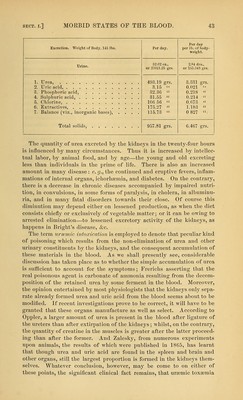
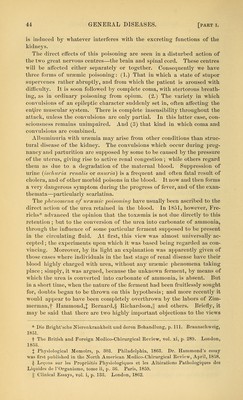
![bile, and the production of amyloid substance or animal dextrine. This anvyloid substance, discovered by Bernard in the liver, is known also to exist normally in other tissues. It differs from the material described by Yirchow as causing amyloid degeneration of various organs, inasmuch as it is free from admixture of azotized matters; whereas the substance found by Virchow is in more or less complete union with nitrogen. (2.) The amyloid substance of Bernard is found in greatest abundance in the hepatic tissue about six hours after a full meal; from this time diminish- ing steadily and gradually if the animal be not fed. A diet containing much starch and sugar greatly increases the amount of amyloid substance formed in the liver (McDonnell and Pavy). And (3.) Diabetes is the result of some defective action of the liver. What this defective action actually consists of, and what are the circumstances which give rise to it, still remain problems to be solved. It has long been known, as already men- tioned, that a temporary diabetes is produced by pricking the floor of the fourth cerebral ventricle; by injuries to the base of the brain and cere- bellum ; by over mental work and anxiety; as well as by derangements of the stomach. Moreover, Dr. Pavy proved, in 1859, that a like con- dition ensues on injuring certain portions of the sympathetic—amongst other parts, the superior cervical ganglion!. But how these various ope- rations act can scarcely be surmised at present. For the sake of convenience, as well as in accordance with custom, the symptoms and diagnosis and treatment of this affection will be con- sidered in the section on renal disorders ; though after the previous re- marks it is hardly necessary to say, that the occurrence of saccharine urine is only a prominent symptom of one or more diseases. 7. URJEMIA The urine is oue of the chief depurating secretions by which the normal condition of the blood is maintained. When, from any cause, the function of the kidneys becomes impaired or suppressed, urea (furnished, in great part at least, from the metamorphosis of the worn-out tissues, uric acid perhaps standing in the relation of an inter- mediate substance) and other substances which these organs ought to remove from the system are no longer eliminated, and they therefore accumulate in the blood, producing that morbid condition known as uraemia [from urea, -}- aifia = blood]. The important amount of work performed by the cells of the uriniferous tubes is very clearly shown in the following table by the Rev. Professor Haughton, of Trinity College, Dublin.* It exhibits the natural daily constants of the urine of the average man ; the analysis giving results corresponding with those generally obtained, save that the uric acid is much below the average—scarcely one-half of the medium quantity dis- charged. From an examination of the table we cannot but infer that suppression of the renal excretion is one of the most dangerous events which can happen: * The Dublin Quarterly Journal of Medical Sciences, vol. xxxiv, p. 288. Dub- lin, 1862.](https://iiif.wellcomecollection.org/image/b21079961_0052.jp2/full/800%2C/0/default.jpg)