Memoirs of the early Italian painters / by Anna Jameson; thoroughly revised and in part rewritten by Estelle M. Hurll.
- Anna Brownell Jameson
- Date:
- 1899
Licence: Public Domain Mark
Credit: Memoirs of the early Italian painters / by Anna Jameson; thoroughly revised and in part rewritten by Estelle M. Hurll. Source: Wellcome Collection.
267/335 page 225
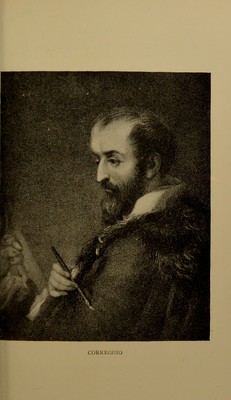
![he died. Though this tradition has been proved to bo false, and is completely refuted by the circumstances of the last years of his life related above, yet the impression that Correggio died miserably and in indigence prevailed to a late period.1 From whatever cause it arose, it was early current. Annibal Carracci, writing from Parma fifty years after the death of Correggio, says, “ I rage and weep to think of the fate of this poor Antonio; so great a man — if, indeed, he were not rather an angel in the flesh — to be lost here, to live unknown, and to die unhappily ! ” Now he who painted the dome of the cathedral of Parma, and who stood' by as one of the chosen witnesses of the marriage of his sovereign, could not have lived unknown and unregarded; and we have no just reason to sup- pose that this gentle, amiable, and unambitious man died un- happily. With regard to his deficient education, it appears certain that he studied anatomy under Lombardi, a famous physician of that time, and his works exhibit not only a classi- cal and cultivated taste, but a knowledge of the sciences — of optics, mathematics, perspective, and chemistry, as far as they were then carried. His use and skilful preparation of rare and expensive colors imply neither poverty nor ignorance. His modest, quiet, amiable temper and domestic habits may have given rise to the report that he lived neglected and obscure in his native city; he had not, like other great masters of his time, an academy for teaching, and a retinue of scholars to spread his name and contend for the supremacy of their master. Whether Correggio ever visited Rome is a point undecided by any evidence for or against, and it is most probable that he did not. It is said that he was at Bologna, where he saw Raphael’s St. Cecilia, and, after contemplating it for some time with ad- miration, he turned away, exclaiming, “ Ancli’ io sono pittore ! ” (And I too am a painter!) — an anecdote which shows that, if unambitious and unpresuming, he was not without a conscious- ness of his own merit.2 [Vasari tells us that Correggio was too modest to paint his own portrait, and never allowed any other artist to do so. Several supposed portraits of Correggio 1 The popular tradition of the death of Correggio is the subject of a very beau- tiful tragedy by OehlenschUiger. 2 [Hr. Julius Meyer calls this anecdote a mere “fable,” declaring that there is no evidence that Correggio visited Bologna, and that, even had lie done so, he could not have seen the St. Cecilia, which was not there at the time.]](https://iiif.wellcomecollection.org/image/b24877888_0267.jp2/full/800%2C/0/default.jpg)