Memoirs of the early Italian painters / by Anna Jameson; thoroughly revised and in part rewritten by Estelle M. Hurll.
- Anna Brownell Jameson
- Date:
- 1899
Licence: Public Domain Mark
Credit: Memoirs of the early Italian painters / by Anna Jameson; thoroughly revised and in part rewritten by Estelle M. Hurll. Source: Wellcome Collection.
46/335 page 12
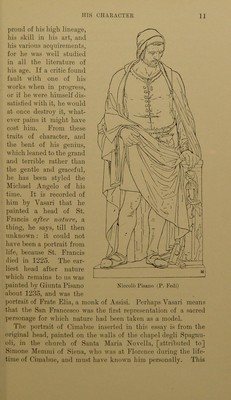
![painting, though executed after the death of Cimahue, has always been considered authentic as a portrait; it is the same alluded to by Vasari, and copied for the first edition of his book. Cimahue had several remarkable contemporaries. The great- est of these, and certainly the greatest artist of his time, was the sculptor Niccolo Pisano [born between 1205 and 1207, died 1278].1 The works of this extraordinary genius which have been preserved to our time are so far beyond all contemporary art in knowledge of form, grace, expression, and intention, that, if indisputable proofs of their authenticity did not exist, it would be pronounced incredible. On a comparison of the works of Cimabue and Pisano, it is difficult to conceive that Pisano executed the bas-reliefs of the pulpit in the cathedral of Pisa while Cimabue was painting the frescoes in the church of Assisi. He was the first to leave the stiff monotony of the traditional forms for the study of nature and the antique. The story says that his emulative fancy was early excited by the beautiful antique sarcophagus on which is seen sculptured the story of Phaedra and Hippolytus. In this sarcophagus had been laid, a hundred years before, the body of Beatrice, the mother of the famous Countess Matilda; in the time of Niccolo it had been inserted into the exterior wall of the Duomo of Pisa, and as a youth he had looked upon it from day to day, until the grace, the life, and movement of the figures struck him, in comparison with the barbarous art of his contemporaries, as nothing less than divine.2 Many before him had looked on this marble wonder, but to none had it spoken as it spoke to him. He was the first, says Lanzi, to see the light and to follow it. There is an engraving after one of his bas-reliefs — a Deposition from the Cross — in Ottley’s “ School of Design,” which should be referred to by the reader who may not have seen his works at Pisa, Plorence, Siena, and Orvieto. There are also several of his works en- graved in Cicognara’s “ Storia della Scultura.” Another contemporary of Cimabue was his friend Gaddo 1 [These dates are on the authority of Charles C. Perkins's Tuscan Sculptors. According to Kosini’s Storia della Pittura, which Mrs. Jameson followed, Nic- colo Pisano worked as late as 1290.] 2 This sarcophagus was restored in 1810 to the Campo Santo, where Beatrice had been interred in 1116.](https://iiif.wellcomecollection.org/image/b24877888_0046.jp2/full/800%2C/0/default.jpg)