Memoirs of the early Italian painters / by Anna Jameson; thoroughly revised and in part rewritten by Estelle M. Hurll.
- Anna Brownell Jameson
- Date:
- 1899
Licence: Public Domain Mark
Credit: Memoirs of the early Italian painters / by Anna Jameson; thoroughly revised and in part rewritten by Estelle M. Hurll. Source: Wellcome Collection.
68/335 page 32
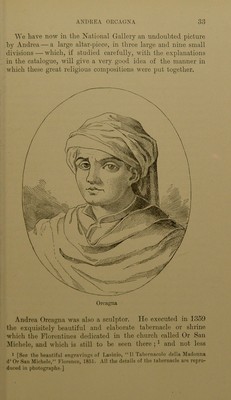
![child, and his influence in his native city remained long after death. Perhaps the perpetual enmity and jealousy between these two famous cities, and frequent sanguinary conflicts, con- spired to keep the two nationalities at variance, even in Art. The scholars and imitators of Ctiotto, who adopted the new method (il nuovo metodo'), as it was then called, and who col- lectively are distinguished as the Scuola Giottesca, may he divided into two classes: 1. Those who were merely his assist- ants and imitators, who confined themselves to the reproduction of the models left by their master. 2. Those who, gifted with original genius, followed his example rather than his instructions, pursued the path he had opened to them, intro- duced better methods of study, more correct design, and car- ried on in various departments the advance of Art into the succeeding century. Of the first it is not necessary to speak. Among the men of great and original genius who immediately succeeded Giotto, three must be especially mentioned for the importance of the works they have left, and for the influence they exercised on those who came after them. These were Andrea Orcagna, Simone Memmi, and Taddeo Gaddi. The first of these, Andrea Cioni, commonly called Andrea Orcagna, did not study under Giotto, but owed much indi- rectly to that vivifying influence which he breathed through Art. Andrea was the son of a goldsmith at Florence. The gold- smiths of the fourteenth and fifteenth centuries were in general excellent designers, and ■ not unfrequently became painters, as in the instances of Francia, Verrochio, Andrea del Sarto, etc. Andrea Orcagna apparently learned design under the tuition of his father. Kosini places his birth previous to the year 1310.1 [His great Avork was the decoration of the Strozzi chapel in the church of S. Maria Novella at Florence. Here he painted on the three principal walls the Last Judgment, Paradise, and the Inferno, and for the same chapel an altar-piece in five compart- ments. These works are characterized by rare qualities of greatness. The laws of composition are perfectly observed. Some of the figures are grand and beautiful. The color is “brilliant and soft,” the harmonies “true and pleasing.” A full description of the work is given by Crowe and Cavalcaselle, in the “History of Painting in Italy,” vol. i. p. 431 et seq.~\ l [Sir Henry Layard gives 1308 as the date of Orcagna’s birth.]](https://iiif.wellcomecollection.org/image/b24877888_0068.jp2/full/800%2C/0/default.jpg)