Memoirs of the early Italian painters / by Anna Jameson; thoroughly revised and in part rewritten by Estelle M. Hurll.
- Anna Brownell Jameson
- Date:
- 1899
Licence: Public Domain Mark
Credit: Memoirs of the early Italian painters / by Anna Jameson; thoroughly revised and in part rewritten by Estelle M. Hurll. Source: Wellcome Collection.
70/335 page 34
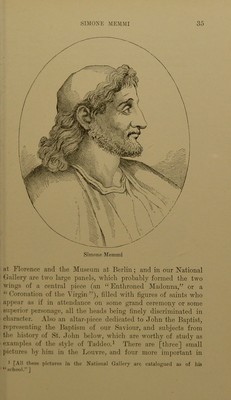
![consummate as an architect than as a sculptor and painter, [he was employed in the works of the l)uomo at Florence and in those of the cathedral at Orvieto. It is no longer believed, however, that he was the builder of the Loggia de’ Lanzi at Florence, though this beautiful portico is still called by his name.1] Simone Martini,2 usually [but incorrectly] called Simone Memmi, was a painter of Siena, of whom very few works re- main, but the friendship of Petrarch has rendered his name illustrious. Simone Memmi was employed at Avignon when it was the seat of the popes (about 1340), and there he painted the portrait of Laura and presented it to Petrarch, who re- warded him with two Sonnets — and immortality. Simone Memmi also painted, in conjunction with Ambrogio Lorenzetti, another Sienese painter, some very extraordinary frescoes in the Palazzo Pubblico, or town hall, of Siena. I have also seen at Naples, in the church of San Lorenzo, a very interesting picture, representing St. Louis of Anjou, bishop of Toulouse, crowning his brother, Pobert of Anjou, as king of Naples, while he is himself crowned by two angels. There is a beautiful little miniature, undoubtedly by him, in the Liver- pool Museum, but we have no specimen in our National Gal- lery. [It was long supposed that some of the frescoes in the Campo Santo at Pisa were by him, as well as the frescoes of the Spanish chapel in Florence. Modern criticism assigns these famous works to other hands.] Simone was certainly one of the most remarkable and interesting painters of his time, and quite independent of the influence of Giotto. He died about 1345.3 The third painter alluded to was Taddeo Gaddi, the favor- ite scholar of Giotto, and his godson.4 His pictures are con- sidered the most important works of the fourteenth century : they resemble the manner of Giotto in the feeling for truth, nature, and simplicity ; but we find in them improved execu- tion, with even more beauty and largeness and grandeur of style. His pictures are numerous : several are in the Academy 1 [It should be said that Perkins attributes the Loggia de’ Lanzi to Orcagna but Sir Henrv Layard declares it not his work.] 2 [Born 1283 ] 3 [In 1344, according to Sir Henry Lavard.] 4 [Born in 1300.]](https://iiif.wellcomecollection.org/image/b24877888_0070.jp2/full/800%2C/0/default.jpg)