Catalogue of the memorials of Linnaeus, exhibited at the conversazione of the President and officers of the Linnean Society, at Burlington House, May 25th, 1888.
- Linnean Society of London
- Date:
- 1888
Licence: Public Domain Mark
Credit: Catalogue of the memorials of Linnaeus, exhibited at the conversazione of the President and officers of the Linnean Society, at Burlington House, May 25th, 1888. Source: Wellcome Collection.
Provider: This material has been provided by The Royal College of Surgeons of England. The original may be consulted at The Royal College of Surgeons of England.
3/18
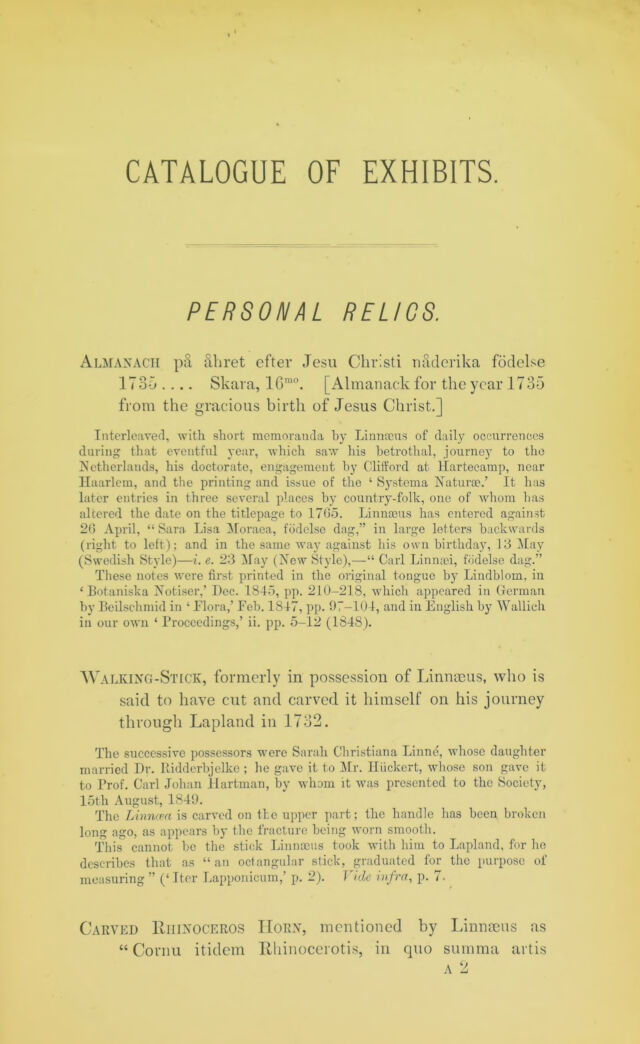
![CATALOGUE OF EXHIBITS. PERSONAL RELICS. Almanack pa ahret efter Jesu Christi naxlerika fodelse 1735 .... Skara, lGmo. [Almanack for the year 1735 from the gracious birth of Jesus Christ.] Interleaved, with short memoranda by Linnaeus of daily occurrences during that eventful year, which saw his betrothal, journey to the Netherlands, his doctorate, engagement by Clifford at Hartecamp, near Haarlem, and the printing and issue of the ‘ Systema Naturae.’ It has later entries in three several places by country-folk, one of whom has altered the date on the titlepage to 1705. Linnaeus has entered against 20 April, “ Sara Lisa Moraea, fodelse dag,” in large letters backwards (right to left); and in the same way against bis own birthday, 13 May (Swedish Style)—i. e. 23 May (New Style),—“ Carl Linnoei, fodelse dag.” These notes were first printed in the original tongue by Lindblom, in ‘Botaniska Notiser,’ Dec. 1845, pp. 210-218, which appeared in German by Beilschmid in ‘ .Flora,’ Feb. 1847, pp. 97-104, and in English by Wallich in our own ‘ Proceedings,’ ii. pp. 5-12 (1848). Walking-Stick, formerly in possession of Linnaeus, who is said to have cut and carved it himself on his journey through Lapland in 1732. The successive possessors were Sarah Christiana Linne, whose daughter married Dr. Ridderbjelke ; he gave it to Air. Iliickert, whose son gave it to Prof. Carl Johan Hartman, by whom it was presented to the Society, 15th August, 1849. The Linncea is carved on the upper part; the handle has been broken long ago, as appears by the fracture being worn smooth. This cannot be the stick Linnaeus took with him to Lapland, for he describes that as “an octangular stick, graduated for the purpose of measuring ” (‘ Iter Lapponicum,’ p. 2). Vide infra, p. 7. Carved Hiiinoceros Horn, mentioned by Linnaeus as “ Cornu itidem Rhinocerotis, in quo summa artis a 2](https://iiif.wellcomecollection.org/image/b22386257_0005.jp2/full/800%2C/0/default.jpg)