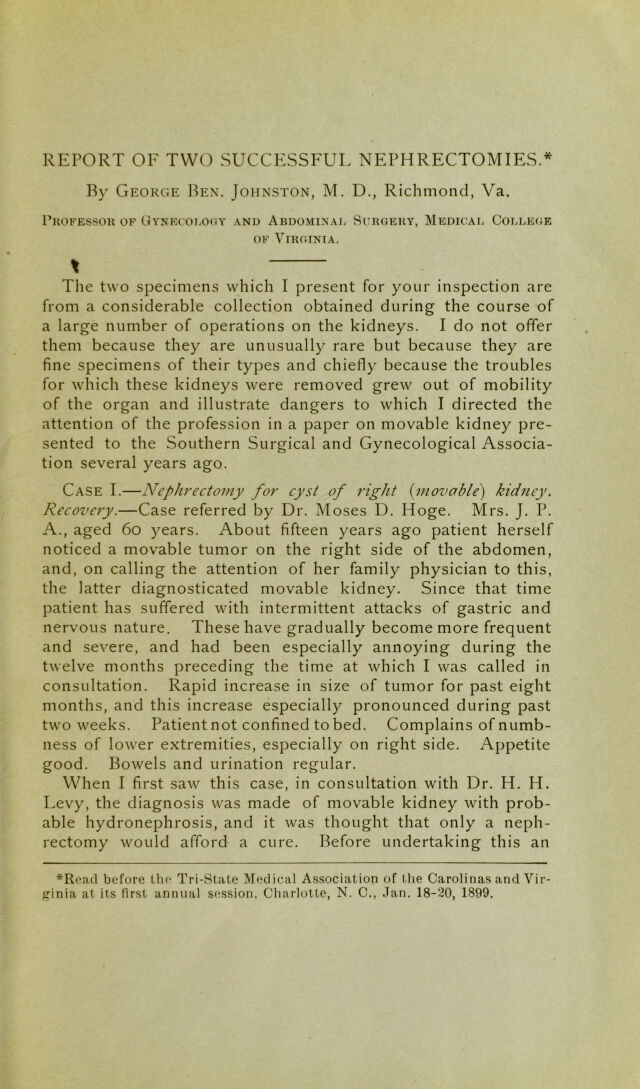
Report of two successful nephrectomies / by George Ben Johnston.
- Johnston, George Ben, 1853-1916
- Date:
- 1899
Licence: Public Domain Mark
Credit: Report of two successful nephrectomies / by George Ben Johnston. Source: Wellcome Collection.
Provider: This material has been provided by The Royal College of Surgeons of England. The original may be consulted at The Royal College of Surgeons of England.
11/14 page 5
![The presence of pus in a frankly acid urine was considered indicative of its-renal origin. Hence the findings in the ex- aminations of the blood and urine in this case led to the opinion that the abdominal tumor was an enlarged and suppurating kidney (^most probably from a calculus) rather than an en- larged spleen. On December lO, 1898, I operated on this case at the Old Dominion Hospital, in the presence of the class of the Medi- cal College of Virginia. The tumor seemed too large to extract through a lumbar incision. I therefore executed a transperitoneal operation through Langenbeck’s incision of the left side. Right kidney examined and found normal, ex- cept hypertrophied. Intestines displayed to the right and protected by gauze sheets. Posterior layer of peritoneum in- cised. The freeing of the kidney was rendered tedious and difficult by many adhesions. The pedicle was ligated in sec- tions, vessels and ureter separately. Considerable oozing occurred and for this reason drainage was established by means of a rubber tube passed through an incision made in the loin. The rent in the peritoneum was closed with a continuous catgut suture and the abdominal wound with silkworm gut and dressed as in Case I. The kidney after removal was found to weigh 435 grams, was of irregular shape and somwhat nodular appearance. [Plate IT] Upon palpation it was felt to contain a large amount of fluid and also a calculus which branched as it ex- tended up from the pelvis of the organ towards the periphery. Upon opening the kidney, 25 cubic centimeters of thick, yel- low pus escaped. The large, branching stone (4.5 centimeters in its longest diameter) was exceedingly friable and was found on analysis to consist of calcium phosphate. There were eight distinct abscess cavities, communicating more or less with each other. Only a small area (about 2 centimeters in length) of apparently normal kidney tissue remained at the upper extremity of the organ. The progress of recovery was reasonably satisfactory. The drain was removed forty-eight hours after the operation. Six days later temperature developed. I reopened the drainage wound and evacuated a considerable collection of pus, after which everything went on smoothly. The patient was dis- charged thirty-eight days after operation.](https://iiif.wellcomecollection.org/image/b2245875x_0013.jp2/full/800%2C/0/default.jpg)