Babylonian and Assyrian medical lore : with special references to dentistry / by B.R. Townend.
- Townend, B. R.
- Date:
- [1941]
Licence: In copyright
Credit: Babylonian and Assyrian medical lore : with special references to dentistry / by B.R. Townend. Source: Wellcome Collection.
20/26 page 16
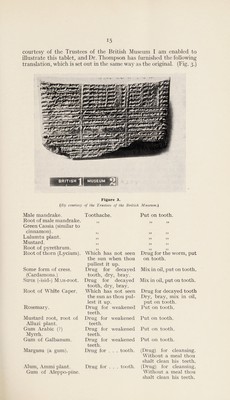
![Dr Thompson tells us that the Assyrian botanist had a fair canacitv for Sviding his herbal into classes according to his needs in rSe intelUgible way. “It is the arrangement of a rathe superficial but laborious cataloguer, but the more the subject st^^died the more obvious appears to have been great knowledge possessed bv the doctors and chemists of Nineveh. (Ihompson - The AssvLn Herbal,- p. XL) It is further pointed out that the influence exerted by these old herbalists upon the plant names of Western languages was of Assyrian names with their Latin equivalents wiU show. ARMANU (Apricot) .Armomca. ARZALLU (Crataegus) AS (Asa-fcetida) KURKANU (Turmeric) LASERBITU (Silphium) PA-PA (Poppy) Azarolus. Asa. Curcuma. Laserpitium. Papaver. I shall now conLder a number of drugs used m ^ssynan Medrane for dental disease, quoting in many cases parallel other t and lands with a view to indicating that the P® substances in dental materia medica appears to I'y® Mesopotamia. My references are by no means compl , Y are then from representative authorities, who passed on their lore down the stream of culture. For convenience, the following abbreviations will be used. Diosc Dioscorides a Greek writer of the ist Century A.D., who togefter with Pliny had a tremendous influence on herbal lore of succeeding ages. My references are taken from the beautiful edition of Robt. T. Gunther. Oxford, Pliny. Thif Natural History of Pliny. Trans by J. Bostock and H. T. Riley. Bohn. London, T-^5d- , c ]vi Syrian Anatomy, Pathology and Therapeutics, or e sCk of Medicines.” Sir A. E. Wallis Budge. Oxford, iQiS. This book was probably written about^ ^o A.JJ. It is for the most pait a translation of Galen’s De Locis Afi'ectis.” The many parallels between prescriptions lor dental and other diseases in this work and m the Assyrian Medical Texts appear to indicate that Galen was indebted to no small extent to Assyrian medicine for h materia medica. When Budge translated the work he considered that it was of native origin, the close simi¬ larity of many of the prescriptions to Assyrian prescrip¬ tions being thus explained, but our later knowledge points strLgly to the probability of influence upon later Greek medicine, thus establish g a link in our continuity. j j t ^ -f-rnm Leech Books. Under this heading 1 have “^uded references from works of the Middle Ages, such as Medical Works of the 14th Century.” G. Henslow. London, 1899. Hiber de Diversis Medicinis ” (15th Century), M. S. Ogde. Early English Text Society, 1938. _ Mydd- vai, ^or the Physicians of Myddyai ” Century), John Pughe. Llandovery, 1861. ” A Leech Book of the 15th Century. ” Warren R. Dawson. London, i934- Herbals. Under this heading I have included Renaissance Herba s such as those of Gerarde, Parkinson, Culpepper, etc.](https://iiif.wellcomecollection.org/image/b30631695_0020.jp2/full/800%2C/0/default.jpg)


 No text description is available for this image
 No text description is available for this image
 No text description is available for this image